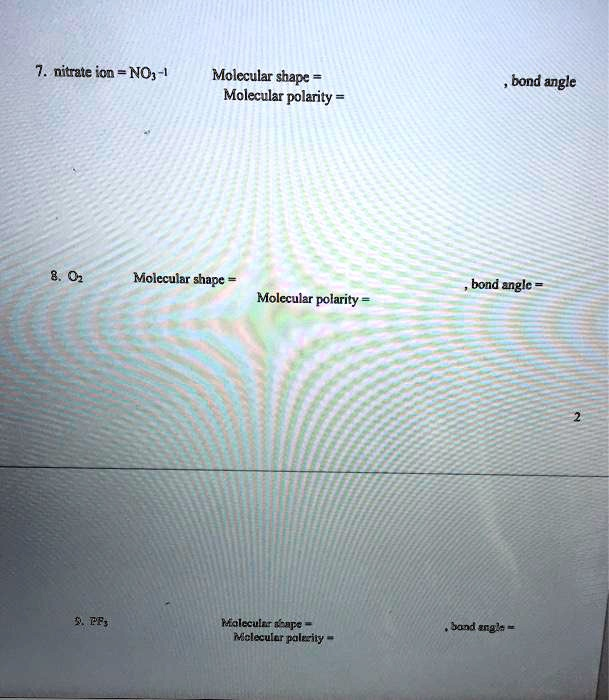
- nitrate ion = NO₃⁻
Molecular shape = Molecular polarity = , bond angle 8.
Molecular shape = Molecular polarity = , bond angle = 5.
Molecular shape = Molecular polarity = , bond angle =
The Correct Answer and Explanation is:
nitrate ion = NO₃⁻
- Molecular shape = Trigonal Planar
- Molecular polarity = Nonpolar
- , bond angle = 120°
8. O₂
- Molecular shape = Linear
- Molecular polarity = Nonpolar
- , bond angle = N/A (Not Applicable** = N/A
9. PF₅
- Molecular shape = Trigonal bipyramidal
- Molecular polarity = Nonpolar
- , bond angle = 90°, 120°
Explanation
The shape and polarity of a molecule are determined by its bonding and the arrangement of its atoms in three-dimensional space, a concept described by the Valence Shell Electron Pair Repulsion (VSEPR) theory. This theory states that electron pairs in the valence shell of a central atom repel each other and will arrange themselves to be as far apart as possible, thus minimizing repulsion and defining the molecule’s geometry.
7. Nitrate Ion (NO₃⁻)
The nitrate ion has a central nitrogen atom bonded to three oxygen atoms. Its Lewis structure shows one double bond and two single bonds, with the overall -1 charge distributed across the atoms. However, this is best represented as three resonance structures, where the double bond is shared among all three oxygen atoms. The result is a resonance hybrid where all three N-O bonds are identical and intermediate between a single and double bond.
- VSEPR Analysis: The central nitrogen atom has three electron domains (the three N-O bonding regions, with double bonds counting as one domain) and no lone pairs.
- Molecular Shape: With three electron domains and no lone pairs, the geometry that maximizes the distance between them is trigonal planar.
- Bond Angle: In a perfect trigonal planar arrangement, the angles between the bonds are 120°.
- Molecular Polarity: Although each N-O bond is polar, the symmetrical trigonal planar arrangement causes the individual bond dipoles to cancel each other out. Therefore, the ion is nonpolar in terms of its dipole moment, even though it carries an overall net charge.
8. Oxygen (O₂)
The oxygen molecule consists of two oxygen atoms joined by a double bond (O=O).
- Molecular Shape: As a diatomic molecule (containing only two atoms), its shape can only be linear.
- Bond Angle: The concept of a bond angle is not applicable (N/A) for a diatomic molecule, as it requires at least three atoms.
- Molecular Polarity: The bond is between two identical atoms, so there is no difference in electronegativity. This makes the O=O bond perfectly covalent and nonpolar. Consequently, the entire molecule is nonpolar.
9. Phosphorus Pentafluoride (PF₅)
In PF₅, the central phosphorus atom is bonded to five fluorine atoms. Phosphorus is in the third period, allowing it to have an expanded octet.
- VSEPR Analysis: The central phosphorus atom has five bonding electron domains and no lone pairs.
- Molecular Shape: The geometry that accommodates five electron domains is trigonal bipyramidal. This)
9. PF₃
- Molecular shape = Trigonal Pyramidal
- Molecular polarity = Polar
- , bond angle = < 109.5°
Explanation
The shape, polarity, and bond angles of molecules are determined by the arrangement of their valence electrons, as described by the Valence Shell Electron Pair Repulsion (VSEPR) theory. This theory states that electron pairs (both bonding and lone pairs) around a central atom will arrange themselves to be as far apart as possible to minimize repulsion, thus defining the molecule’s geometry.
7. Nitrate Ion (NO₃⁻)
The nitrate ion has a central nitrogen atom bonded to three oxygen atoms. It has 24 valence electrons in total. Its Lewis structure features one double bond and two single bonds, but these bonds exhibit resonance, meaning the true structure is an average of three resonance forms. As a result, all three N-O bonds are identical and equivalent. According to VSEPR theory, the three electron domains (the three N-O bonds) around the central nitrogen atom will arrange themselves in a trigonal planar geometry to maximize their separation. Since there are no lone pairs on the nitrogen, the molecular shape is also trigonal planar. The ideal bond angle for this arrangement is 120°. Although each N-O bond is polar, the symmetrical arrangement of the bonds causes the individual bond dipoles to cancel each other out, making the overall ion nonpolar (it has no net dipole moment, though it does carry a formal charge).
8. Oxygen (O₂)
The oxygen molecule consists of two oxygen atoms sharing a double bond (O=O). As a diatomic molecule, its shape can only be linear. A shape features two distinct positions: three equatorial atoms in a plane around the center and two axial atoms above and below that plane.
- Bond Angle: This geometry results in two different bond angles. The angle between the equatorial fluorine atoms is 120°, while the angle between an axial fluorine and an equatorial fluorine is 90°.
- Molecular Polarity: Each P-F bond is highly polar due to the large electronegativity difference. However, the molecule’s overall shape is highly symmetrical. The three equatorial bond dipoles cancel out in their plane, and the two axial bond dipoles point in opposite directions and also cancel out. Because all bond dipoles cancel, PF₅ is a nonpolar molecule. bond angle is not applicable as it requires at least three atoms. The molecule is nonpolar because the bond is between two identical atoms, meaning there is no difference in electronegativity and the electron density is shared equally.
9. Phosphorus Trifluoride (PF₃)
In PF₃, the central phosphorus atom is bonded to three fluorine atoms and has one lone pair of electrons. This gives the central atom a total of four electron domains (three bonding pairs and one lone pair). These four domains arrange themselves in a tetrahedral electron geometry. However, the molecular shape only considers the position of the atoms. With three bonding atoms and one lone pair, the shape is trigonal pyramidal. The ideal tetrahedral bond angle is 109.5°, but the lone pair exerts a stronger repulsive force than the bonding pairs, pushing the fluorine atoms closer together. This results in a F-P-F bond angle that is less than 109.5° (approximately 97.7°). The molecule is polar because the P-F bonds are polar (fluorine is highly electronegative), and the asymmetrical trigonal pyramidal shape prevents the bond dipoles from canceling, creating a net dipole moment.