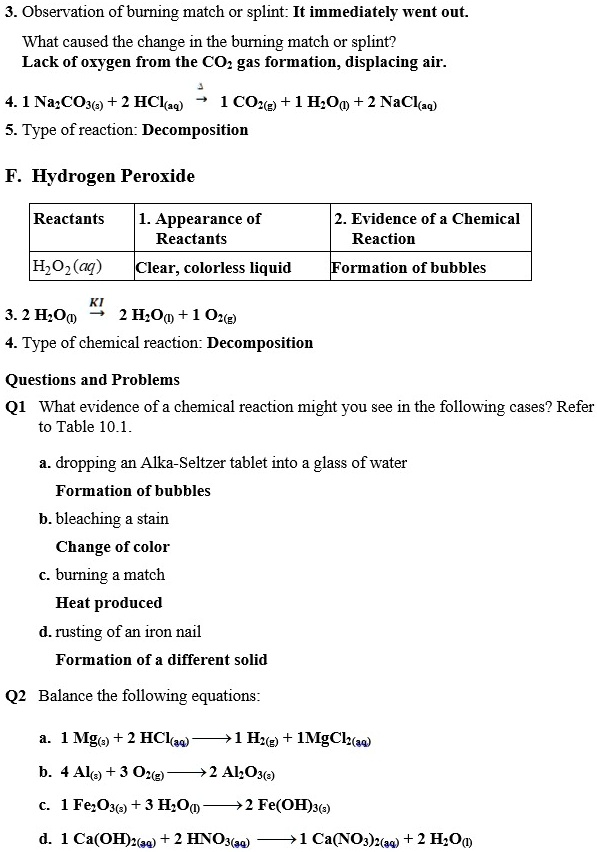
Observation of burning match or splint: It immediately went out. What caused the change in the burning match or splint? Lack of oxygen from the CO2 gas formation, displacing air: NaCO2 + 2 HCl(aq) → CO2 + H2O + NaCl(aq). Type of reaction: Decomposition. Hydrogen Peroxide Reactants: 1. Appearance of Reactants: Clear; colorless liquid. Evidence of Chemical Reaction: H2O2 (aq) → H2O + O2. Formation of bubbles. 3.2 H2O2 → 2 H2O + 1 O2. Type of chemical reaction: Decomposition. Questions and Problems: Q1 What evidence of chemical reaction might you see in the following cases? Refer to Table 10.1. – Dropping an Alka-Seltzer tablet into a glass of water: Formation of bubbles. – Bleaching stain: Change of color. – Burning match: Heat produced. – Rusting of an iron nail: Formation of a different solid. Q2 Balance the following equations: 1. Mg(s) + 2 HCl(aq) → MgCl2(aq) + H2(g). 2. 2 Al(s) + 3 O2(g) → 2 Al2O3(s). 3. Fe(OH)3(s) + 3 H2O2(aq) → Fe(OH)2(s) + 2 H2O(l). 4. Ca(OH)2(aq) + 2 HNO3(aq) → Ca(NO3)2(aq) + 2 H2O(l)
The Correct Answer and Explanation is:
Here is the corrected version of the provided text, followed by a detailed explanation.
Corrected Information
- Observation of burning match or splint: It immediately went out.
What caused the change in the burning match or splint? Lack of oxygen from the CO₂ gas formation, displacing air. - 1 Na₂CO₃(s) + 2 HCl(aq) → 1 CO₂(g) + 1 H₂O(l) + 2 NaCl(aq)
- Type of reaction: Double Displacement (or Acid-Base Reaction)
F. Hydrogen Peroxide
| Reactants | 1. Appearance of Reactants | 2. Evidence of a Chemical Reaction |
| :— | :— | :— |
| H₂O₂(aq) | Clear, colorless liquid | Formation of bubbles |
- 2 H₂O₂(l)
→KIKI2 H₂O(l) + 1 O₂(g) - Type of chemical reaction: Decomposition
Questions and Problems
Q1 What evidence of a chemical reaction might you see in the following cases?
a. dropping an Alka-Seltzer tablet into a glass of water
Formation of bubbles
b. bleaching a stain
Change of color
c. burning a match
Heat produced
d. rusting of an iron nail
Formation of a different solid
Q2 Balance the following equations:
a. 1 Mg(s) + 2 HCl(aq) → 1 H₂(g) + 1 MgCl₂(aq)
b. 4 Al(s) + 3 O₂(g) → 2 Al₂O₃(s)
c. 1 Fe₂O₃(s) + 3 H₂O(l) → 2 Fe(OH)₃(s)
d. 1 Ca(OH)₂(aq) + 2 HNO₃(aq) → 1 Ca(NO₃)₂(aq) + 2 H₂O(l)
Explanation
This worksheet explores fundamental concepts in chemistry, including identifying chemical reactions, classifying reaction types, and balancing chemical equations.
Evidence of Chemical Change
A chemical reaction involves the transformation of substances into new ones with different properties. Question Q1 correctly identifies several key indicators of a chemical reaction. The formation of bubbles (a gas), a change in color, the production of heat or light, and the formation of a new solid (a precipitate) are all common signs that a chemical change has occurred.
Types of Chemical Reactions
Correctly classifying reactions helps in predicting their products. Two errors were corrected in this section:
- The reaction between sodium carbonate (Na₂CO₃) and hydrochloric acid (HCl) is best classified as a double displacement reaction. In this type of reaction, the positive and negative ions of two ionic compounds switch places: AB + CD → AD + CB. Here, Na⁺ pairs with Cl⁻, and H⁺ pairs with CO₃²⁻. The product H₂CO₃ (carbonic acid) is unstable and immediately decomposes into water (H₂O) and carbon dioxide (CO₂) gas. While decomposition is part of the process, the overall reaction type is double displacement.
- The decomposition of hydrogen peroxide is correctly identified as a decomposition reaction, where a single compound breaks down into two or more simpler substances (AB → A + B). The original equation contained a critical typo, listing the reactant as H₂O (water). The correct formula is H₂O₂ (hydrogen peroxide). Water is a stable compound that does not decompose under these conditions, whereas hydrogen peroxide readily breaks down, especially with a catalyst like potassium iodide (KI), to form water and oxygen gas.
Balancing Chemical Equations
The law of conservation of mass states that matter cannot be created or destroyed. Therefore, a chemical equation must be balanced, meaning it must have the same number of atoms of each element on both the reactant and product sides. All equations in Q2 are correctly balanced, demonstrating this principle. For example, in 4 Al + 3 O₂ → 2 Al₂O₃, there are 4 aluminum atoms and 6 oxygen atoms on both sides of the arrow.
