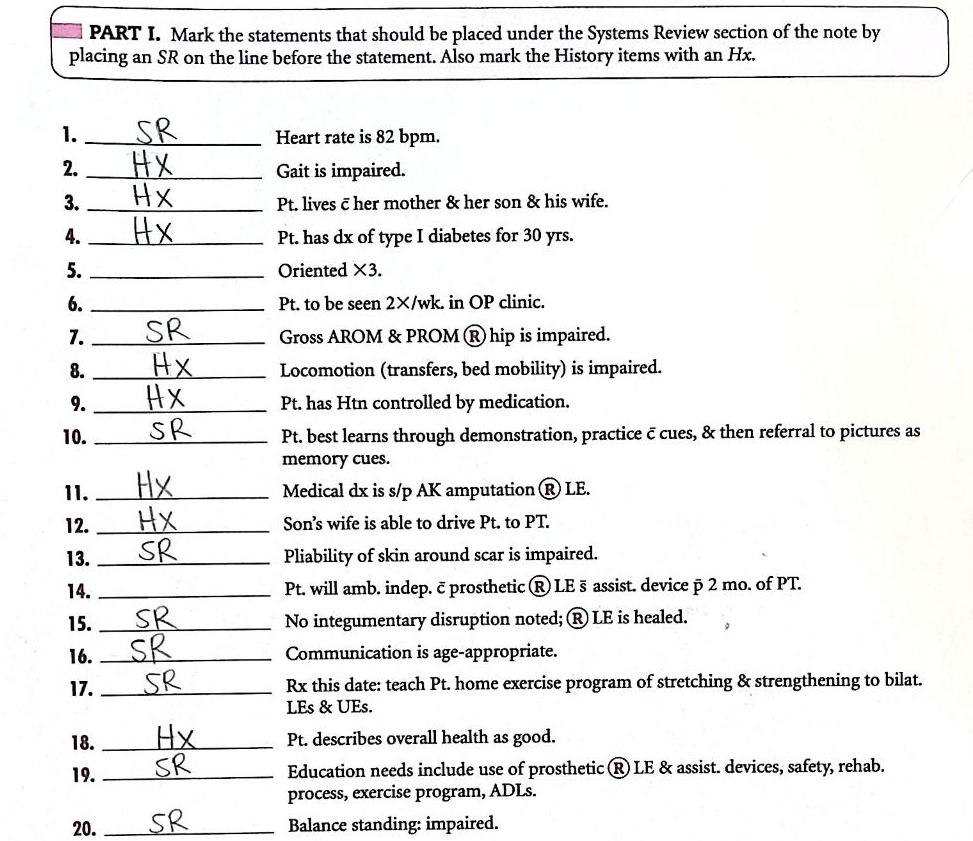
Mark the statements that should be placed under the Systems Review section of the note by placing an SR on the line before the statement. Also mark the History items with an Hx. 1. 2. 3. 4. 5. 6. 7. 8. 9. SR Hx Hx XH Heart rate is 82 bpm. Gait is impaired. Pt. lives with her mother & her son & his wife. Pt. has dx of type I diabetes for 30 yrs. Oriented X3. Pt. to be seen 2X/wk. in OP clinic. Gross AROM & PROM hip is impaired. Locomotion (transfers, bed mobility) is impaired. SR Hx Hx SR Pt. has Htn controlled by medication. Pt. best learns through demonstration, practice cues, & then referral to pictures as memory cues. Medical dx is s/p AK amputation LE. Son’s wife is able to drive Pt. to PT. Pliability of skin around scar is impaired. Pt. will amb. indep. C prosthetic LE s assist. device p 2 mo. of PT. No integumentary disruption noted; LLE is healed. Communication is age-appropriate. Rx this date: teach Pt. home exercise program of stretching & strengthening to bilateral LEs & UEs. Pt. describes overall health as good. Education needs include use of prosthetic LE & assist. devices, safety, rehab. process, exercise program, ADLs. Balance standing: impaired. 10. Hx Hx SR 11. 12. 13. 14. 15. 16. 17. SR SP SR XH SR 18. 19. SR 20.
The Correct Answer and Explanation is:
Based on the standards for physical therapy documentation, here are the correct classifications for each statement.
Correct Answers
- SR – Heart rate is 82 bpm.
- SR – Gait is impaired.
- Hx – Pt. lives c her mother & her son & his wife.
- Hx – Pt. has dx of type I diabetes for 30 yrs.
- SR – Oriented x3.
- Neither – Pt. to be seen 2X/wk. in OP clinic.
- SR – Gross AROM & PROM ® hip is impaired.
- SR – Locomotion (transfers, bed mobility) is impaired.
- Hx – Pt. has Htn controlled by medication.
- SR – Pt. best learns through demonstration, practice c cues, & then referral to pictures as memory cues.
1 Items in the SR are the clinician’s findings. This includes:
- Cardiovascular: Vital signs like heart rate (#1).
- Integumentary: The condition of the skin, such as its pliability (#13) and integrity (#15).
- Musculoskeletal: A gross assessment of joint motion (#7).
- Neuromuscular: Observations of functional movement like gait (#2), locomotion (#8), and balance (#20).
- Communication/Cognition: Assessment of alertness, orientation (#5), communication ability (#16), and learning style (#10).
Statements #6, #14, #17, and #19 do not belong in either section. These items relate to the Plan of Care, detailing treatment frequency, goals, interventions, and educational needs for future sessions.1. Hx – Medical dx is s/p AK amputation ® LE.
12. Hx – Son’s wife is able to drive Pt. to PT.
13. SR – Pliability of skin around scar is impaired.
14. Neither – Pt. will amb. indep. c prosthetic ® LE s assist. device p 2 mo. of PT.
15. SR – No integumentary disruption noted; ® LE is healed.
16. SR – Communication is age-appropriate.
17. Neither – Rx this date: teach Pt. home exercise program of stretching & strengthening to bilat. LEs & UEs.
18. Hx – Pt. describes overall health as good.
19. Neither – Education needs include use of prosthetic ® LE & assist. devices, safety, rehab. process, exercise program, ADLs.
20. SR – Balance standing: impaired.
Explanation
The key distinction is between information gathered by report versus information obtained through direct screening by the therapist.
History (Hx) includes information reported by the patient, their family, or their medical chart. This covers their past medical conditions, living situation, and personal feelings about their health. Items like medical diagnoses (#4, #9, #11), social situation (#3, #12), and the patient’s own description of health (#18) fall into this category.
Systems Review (SR) is a brief, hands-on screening of the body’s major systems performed by the clinician. It involves direct observation and measurement.
- Cardiopulmonary: Measuring heart rate (#1).
- Integumentary: Observing skin condition and scar pliability (#13, #15).
- Musculoskeletal: Assessing gross range of motion (#7).
- Neuromuscular: Observing functional movements like gait (#2), locomotion (#8), and balance (#20).
- Cognition/Communication: Assessing orientation (#5), communication ability (#16), and learning style (#10).
Several items in the original image were miscategorized. For instance, “Gait is impaired” (#2) and “Locomotion…is impaired” (#8) are direct clinical observations of the