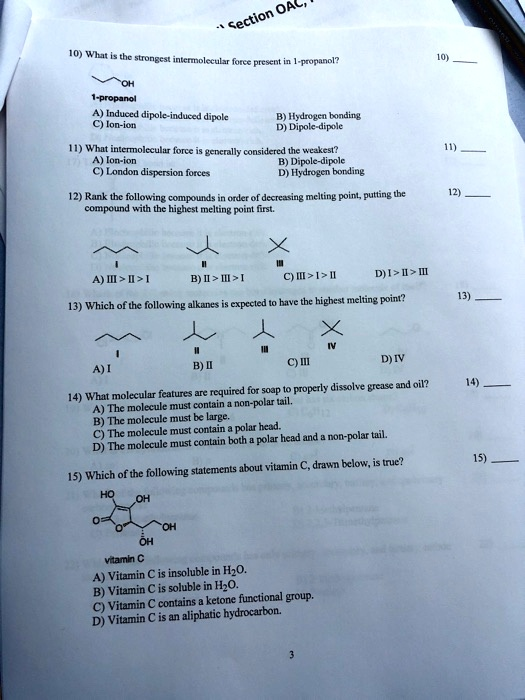
OAC Section _ What is the strongest intermolecular force present in Propanol? A) Induced dipole-induced dipole B) Hydrogen bonding C) Dipole-dipole D) London dispersion force 2. Rank the following compounds in order of decreasing melting point, with the compound with the highest melting point first: A) I > M > [ B) II > M > [ C) III > [ > II D) [ > II > III 3. Which of the following alkanes is expected to have the highest melting point? A) I B) II C) III D) IV 4. What molecular features are required for a soap molecule to properly dissolve in water? A) The molecule must have a non-polar tail. B) The molecule must be polarized. C) The molecule must contain both a polar head and a non-polar tail. D) The molecule must contain a ketone functional group. 5. Which of the following statements about vitamin C is true? A) Vitamin C is insoluble in water. B) Vitamin C is soluble in water. C) Vitamin C contains a ketone functional group. D) Vitamin C is an aliphatic hydrocarbon.
The Correct Answer and Explanation is:
Correct Answer: B) Vitamin C is soluble in H₂O.
Explanation:
The solubility of a substance is governed by the principle “like dissolves like.”
- Vitamin C’s Structure: The molecule of vitamin C (ascorbic acid) has multiple polar hydroxyl (-OH) groups.
- Interaction with Water: Water (H₂O) is a highly polar solvent. The polar -OH groups on vitamin C can form strong hydrogen bonds with water molecules.
- Solubility: Because of these strong attractions between vitamin C and water molecules, vitamin C dissolves readily in water.
- Other Options:
- (C) It contains a lactone (a cyclic ester), not a ketone. A ketone has a C=O group bonded to two other carbons.
- (D) It is not an aliphatic hydrocarbon, as it contains multiple oxygen atoms and functional groups.