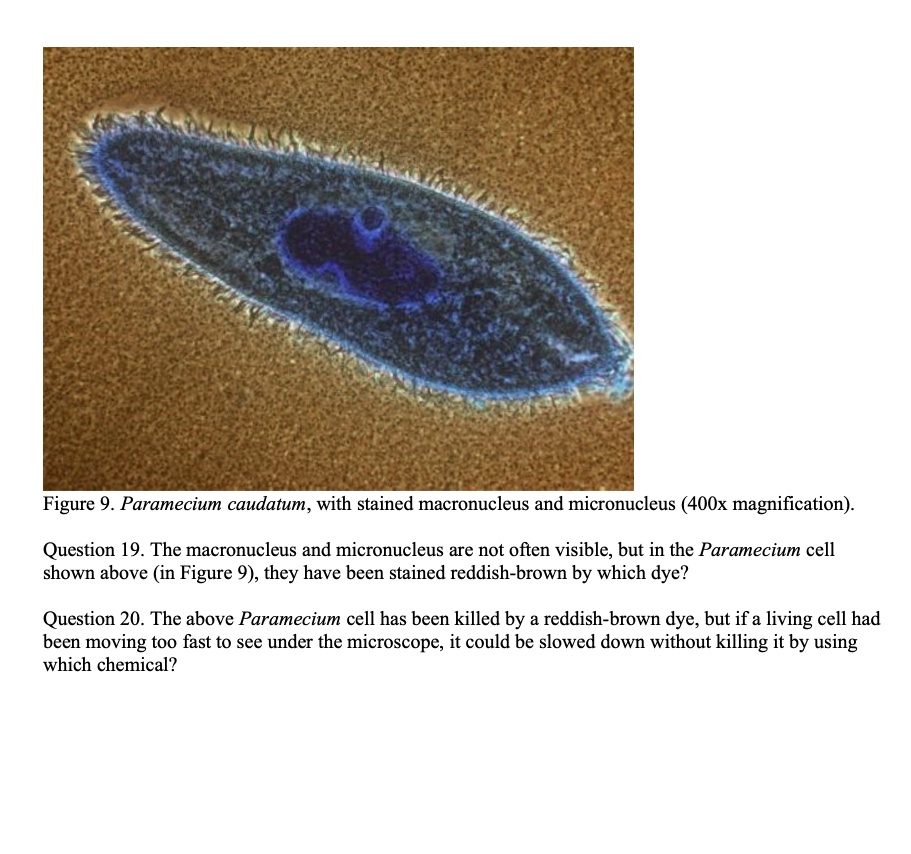
Paramecium caudatum, with stained macronucleus and micronucleus (400x magnification) Question 19. The macronucleus and micronucleus are not often visible, but in the Paramecium cell shown above (in Figure 9), they have been stained reddish-brown by which dye? Question 20. The above Paramecium cell has been killed by a reddish-brown dye, but if a living cell had been moving too fast to see under the microscope, it could be slowed down without killing it by using which chemical?
The Correct Answer and Explanation is:
Answer
Question 19: Lugol’s iodine (or iodine solution).
Question 20: Methyl cellulose.
Explanation
The observation of microorganisms like Paramecium in a laboratory setting often requires specific chemicals to prepare them for viewing under a microscope. The answers to both questions highlight two common, yet distinct, preparation techniques.
Staining for Internal Structures (Question 19)
The chemical used to stain the macronucleus and micronucleus reddish-brown is Lugol’s iodine. In their natural, unstained state, the internal organelles of a Paramecium, including the large macronucleus and the smaller, adjacent micronucleus, are mostly transparent and difficult to see clearly. Lugol’s iodine is a solution that serves a dual purpose as a fixative and a stain. Upon application, it instantly kills the organism, halting all movement and cellular processes. This fixation helps to preserve the cell’s structure. Simultaneously, the iodine component of the solution stains specific cellular parts. It imparts a yellowish to reddish-brown color to the cytoplasm and, most notably, the nucleus, making these structures opaque and easily distinguishable from the rest of the cell. This method is excellent for studying the detailed morphology of a non-living specimen. While the provided image shows a blue-stained nucleus, which could be from a different stain or a result of specific lighting like Differential Interference Contrast (DIC) microscopy, the question specifically refers to a reddish-brown dye, a classic characteristic of iodine staining.
Slowing for Live Observation (Question 20)
To observe a living Paramecium without killing it, a chemical called methyl cellulose is commonly used. Paramecium cells are covered in cilia that beat rapidly, propelling them quickly through water. This constant, swift motion makes it nearly impossible to keep them in the field of view of a microscope for detailed study. Adding a drop of methyl cellulose solution to the water sample addresses this problem. Methyl cellulose is a long-chain polymer that dissolves in water to create a viscous, syrupy medium. This thick liquid increases the drag on the Paramecium, physically impeding the movement of its cilia. The organism is still alive and can be observed carrying out life processes, such as feeding or the pulsing of its contractile vacuoles, but its forward motion is dramatically slowed. This technique is invaluable for studying the behavior and dynamic functions of the living cell.