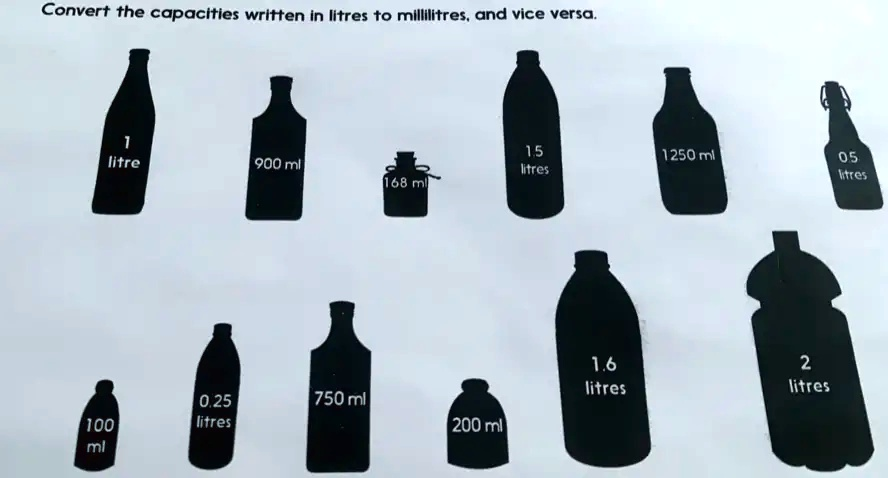
Convert the capacities written in litres to millilitres, and vice versa. 1 litre 900 ml 1.5 litres 1250 ml 0.5 litres 168 ml 1.6 litres 2 litres 100 ml 0.25 litres 750 ml 200 ml
The Correct Answer and Explanation is:
Based on the image provided, here are the correct conversions for each container’s capacity.
Correct Conversions
From Litres to Millilitres:
- 1 litre = 1000 ml
- 1.5 litres = 1500 ml
- 0.5 litres = 500 ml
- 0.25 litres = 250 ml
- 1.6 litres = 1600 ml
- 2 litres = 2000 ml
From Millilitres to Litres:
- 900 ml = 0.9 litres
- 168 ml = 0.168 litres
- 1250 ml = 1.25 litres
- 100 ml = 0.1 litres
- 750 ml = 0.75 litres
- 200 ml = 0.2 litres
Explanation
This exercise demonstrates the conversion of liquid capacity measurements between litres (l) and millilitres (ml). The task is to take the value provided for each container in the image and express it in the alternate unit. The key to performing these conversions correctly is understanding the direct, base-ten relationship between the two units within the metric system.
The fundamental principle is that one litre is equivalent to one thousand millilitres (1 l = 1000 ml). The prefix ‘milli-‘ itself means one-thousandth. This single conversion factor is the foundation for all the calculations required to solve the problems presented.
To convert a capacity from litres to millilitres, the given number of litres must be multiplied by 1000. For instance, the bottle labeled ‘1.5 litres’ is converted by calculating 1.5 multiplied by 1000, which results in 1500 ml. Similarly, the bottle marked ‘2 litres’ has a capacity of 2 times 1000, equaling 2000 ml. This mathematical operation can be simply thought of as shifting the decimal point three places to the right. For the value ‘0.25 litres’, moving the decimal point three places to the right gives the correct answer of 250 ml.
Conversely, to convert a capacity from millilitres to litres, the opposite operation is needed. The given number of millilitres must be divided by 1000. Taking the container marked ‘900 ml’ as an example, dividing 900 by 1000 gives 0.9 litres. For the ‘1250 ml’ bottle, the calculation is 1250 divided by 1000, which equals 1.25 litres. This division can be visualized as shifting the decimal point three places to the left. Applying this rule to the ‘100 ml’ bottle results in 0.1 litres.
By consistently applying these straightforward rules of multiplication or division by 1000, any capacity can be accurately expressed in either unit, fulfilling the objective of the exercise.