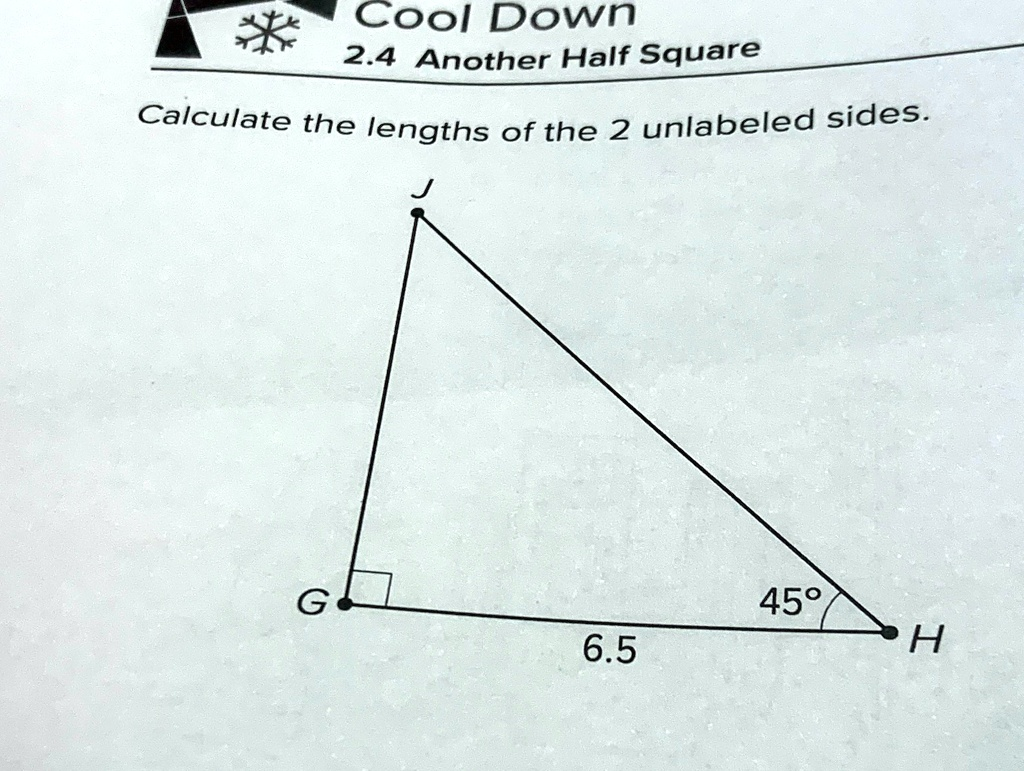
Cool Down 2.4 Another Half Square Calculate the lengths of the 2 unlabeled sides. J G 45° H 6.5
The Correct Answer and Explanation is:
The right triangle in the image has a 45-degree angle at vertex H and a given adjacent side length of 6.5 units (GH). To determine the two missing side lengths, JG and JH, trigonometric principles are applied.
Calculations:
- Finding JG: Using the tangent function:
tan(45°)=oppositeadjacent=JGGH\tan(45°) = \frac{\text{opposite}}{\text{adjacent}} = \frac{JG}{GH}
Since tan(45°)=1\tan(45°) = 1, solving for JG:
JG=6.5 unitsJG = 6.5 \text{ units}
- Finding JH: Applying the Pythagorean theorem:
JH2=JG2+GH2JH^2 = JG^2 + GH^2
Substituting values:
JH2=6.52+6.52JH^2 = 6.5^2 + 6.5^2
JH2=42.25+42.25JH^2 = 42.25 + 42.25
JH2=84.5JH^2 = 84.5
Taking the square root:
JH=84.5≈9.19 unitsJH = \sqrt{84.5} \approx 9.19 \text{ units}
Explanation:
This right triangle contains a 45-degree angle, which suggests an application of trigonometric ratios and the Pythagorean theorem. The tangent function establishes the relationship between the opposite and adjacent sides, allowing the determination of JG. With the known adjacent side length of 6.5 units and the tangent of 45 degrees equating to 1, the opposite side length must also be 6.5 units.
Once both legs are identified, the Pythagorean theorem is employed to solve for the hypotenuse JH. The theorem dictates that the square of the hypotenuse equals the sum of the squares of the two legs. Substituting the known values results in a hypotenuse length of approximately 9.19 units.
This solution demonstrates how trigonometric principles and fundamental geometric relationships provide a structured approach to solving right triangle problems effectively.