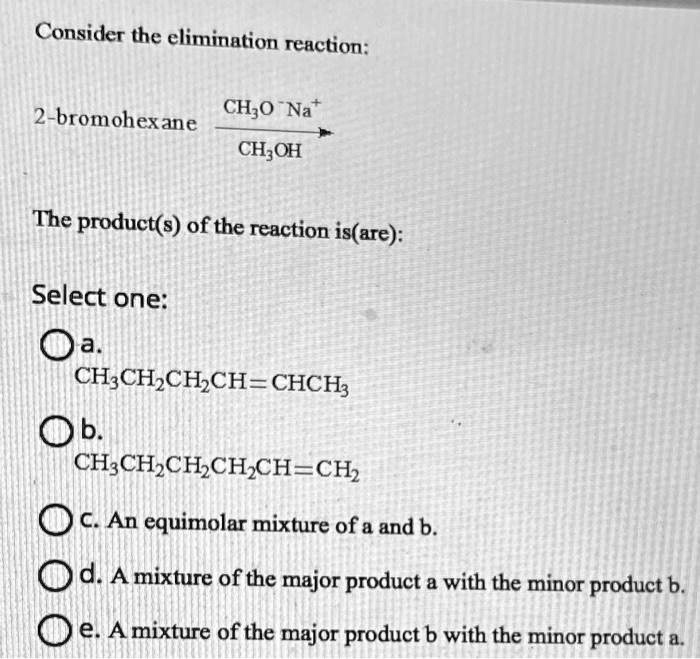
Consider the elimination reaction: 2-bromohexane CH3CH2CH2CH2CH2CH2Br + NaOH → CH3CH2CH2CH2CH2CH2OH + NaBr The product(s) of the reaction is(are): Select one: a. CH3CH=CHCH2CH2CH3 b. CH3CH2CH2CH2CH=CH2 c. An equimolar mixture of a and b. d. A mixture of the major product a with the minor product b. e. A mixture of the major product b with the minor product
The Correct Answer and Explanation is:
The elimination reaction of 2-bromohexane with sodium hydroxide proceeds via the E2 mechanism, given that the reaction involves a strong base. In this mechanism, the base abstracts a proton from the β-carbon (the carbon adjacent to the carbon bearing the leaving group), leading to the formation of a double bond and the expulsion of the leaving group (bromine).
Determining the Major and Minor Products:
For 2-bromohexane, elimination can occur in two different ways:
- Formation of CH3CH=CHCH2CH2CH3 This product forms when the base abstracts a proton from the carbon adjacent to the more substituted site, leading to a more stable, more substituted alkene.
- Formation of CH3CH2CH2CH2CH=CH2 This product forms when the base abstracts a proton from the less substituted carbon, yielding a less substituted alkene.
Applying Zaitsev’s Rule:
According to Zaitsev’s Rule, the more substituted alkene is favored as the major product. This means that CH3CH=CHCH2CH2CH3 is major, while CH3CH2CH2CH2CH=CH2 is minor.
Correct Answer:
The reaction yields a mixture of products, with CH3CH=CHCH2CH2CH3 as the major product and CH3CH2CH2CH2CH=CH2 as the minor product. Therefore, the correct answer is: d. A mixture of the major product a with the minor product b.
This result aligns with Zaitsev’s Rule, which predicts the formation of the most substituted and most stable alkene in E2 elimination. The reaction favors thermodynamic stability, making the more substituted product predominant in the mixture.