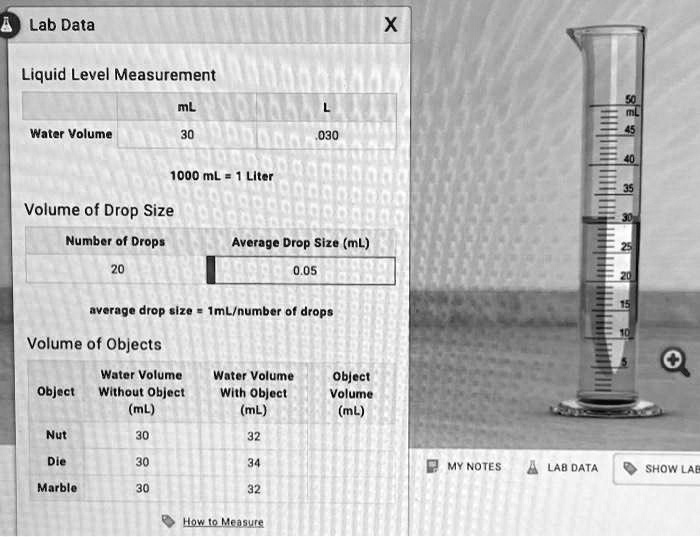
Liquid Level Measurement Water Volume 030 000 mL = Liter Volume of Drop Size Number of Drops Average Drop Size (mL) 0.05 average drop size (mL/number of drops) Volume of Objects Water Volume Object Without Object (mL) Water Volume With Object (mL) Object Volume (mL) Nut Die MY NOTES LAB DATA SHOW LATE Marble How to Measure
The Correct Answer and Explanation is:
Correct Answers from the Lab Data Image:
Liquid Level Measurement:
- Water Volume:
- mL: 30
- L: 0.030
Volume of Drop Size:
- Number of Drops: 20
- Average Drop Size: 0.05 mL
Volume of Objects:
| Object | Water Volume Without Object (mL) | Water Volume With Object (mL) | Object Volume (mL) |
|---|---|---|---|
| Nut | 30 | 32 | 2 |
| Die | 30 | 34 | 4 |
| Marble | 30 | 32 | 2 |
Explanation
This lab data chart provides measurements related to liquid volume, average drop size, and the volume of solid objects using water displacement. To begin with, the liquid level measurement shows that 30 milliliters of water equals 0.030 liters. This conversion is correct, based on the fact that 1000 milliliters is equal to 1 liter.
Next, the chart shows data on average drop size. It mentions that 20 drops are required to make up 1 milliliter. By dividing 1 milliliter by 20 drops, the result is 0.05 milliliters per drop. This value matches the displayed average drop size. This method is commonly used to estimate the volume of small quantities of liquid by counting drops.
The volume of objects is determined using the water displacement method. This technique involves measuring how much the water level rises when an object is submerged. For each item, the initial volume without the object is recorded as 30 milliliters. When the object is placed in the water, the volume increases. The difference between these two measurements represents the volume of the object.
For example, when the nut is added to the water, the volume rises from 30 to 32 milliliters. Therefore, the volume of the nut is 2 milliliters. The same method is applied to the die and marble. The die increases the volume to 34 milliliters, giving it a volume of 4 milliliters. The marble increases the volume to 32 milliliters, giving it a volume of 2 milliliters.
This experiment demonstrates basic concepts of volume, unit conversions, and the water displacement method used in measuring irregular-shaped objects.