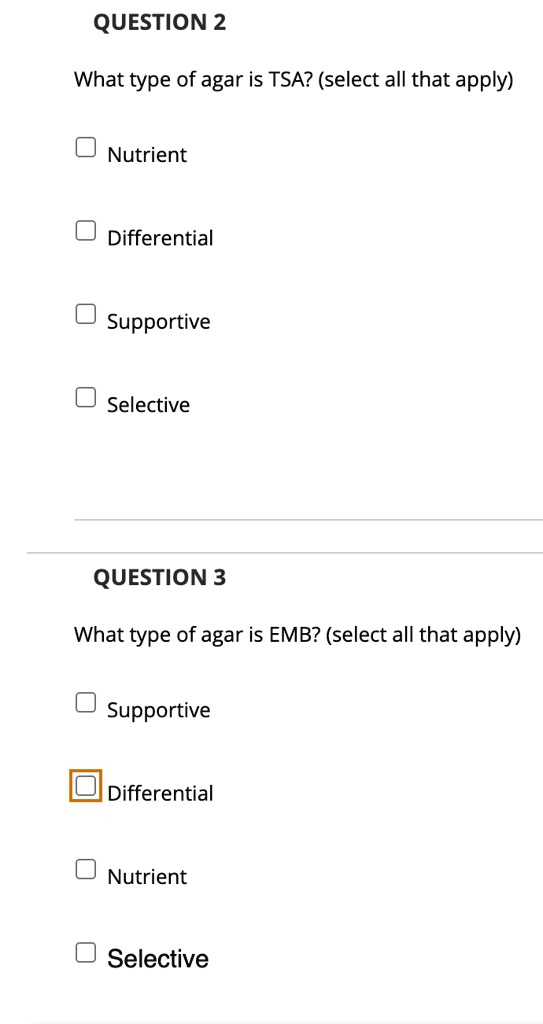
What type of agar is TSA? (select all that apply) Nutrient Differential Supportive Selective QUESTION 3 What type of agar is EMB? (select all that apply) Supportive Differential Nutrient Selective
The Correct Answer and Explanation is:
Correct Answers:
- TSA (Tryptic Soy Agar): Nutrient, Supportive
- EMB (Eosin Methylene Blue Agar): Differential, Selective
Explanation: Tryptic Soy Agar (TSA) is a general-purpose medium that provides essential nutrients for microbial growth. It is categorized as a nutrient agar because it contains components such as enzymatic digests of soy and casein that support diverse bacterial and fungal growth. TSA is also considered supportive since it facilitates the proliferation of a wide range of microorganisms, including fastidious bacteria that require specific nutrients. However, TSA is not a selective medium because it does not inhibit certain bacterial species while allowing others to grow. Additionally, TSA is not differential since it lacks indicators that visually distinguish bacterial colonies based on metabolic activity.
Eosin Methylene Blue (EMB) agar, on the other hand, serves both selective and differential functions. It is selective because the dyes eosin and methylene blue suppress the growth of Gram-positive bacteria, making it more suitable for isolating Gram-negative species. EMB is also a differential medium due to its ability to distinguish between lactose fermenters and non-fermenters. Organisms capable of fermenting lactose produce acid, causing the dyes to precipitate and resulting in colonies with characteristic dark centers or a metallic green sheen, as seen with Escherichia coli. Non-fermenters appear colorless or exhibit a pale pink hue. EMB does not function as a general nutrient medium or a purely supportive environment, since its primary role is differentiation and selective bacterial growth.
These classifications are essential in microbiology as they influence experimental design and microbial identification strategies, ensuring that appropriate media are used to cultivate and analyze bacterial species.
