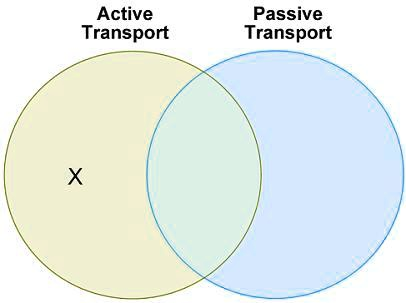
Active Transport Passive Transport X
The Correct Answer and Explanation is:
Active transport and passive transport are two fundamental mechanisms by which cells move substances across their membranes. The key difference lies in energy usage and direction of movement relative to concentration gradients.
Active transport requires energy input from the cell, typically in the form of ATP. This process moves molecules against their concentration gradient, meaning from areas of lower concentration to higher concentration. It is essential for maintaining cellular homeostasis by regulating ion concentrations and nutrient uptake. Common examples include the sodium-potassium pump, which maintains electrochemical gradients in nerve cells, and the uptake of glucose in the intestines.
Passive transport, on the other hand, does not require cellular energy. It relies on the natural movement of molecules down their concentration gradient, meaning from areas of higher concentration to lower concentration. This process includes diffusion, facilitated diffusion, and osmosis. Diffusion allows small molecules like oxygen and carbon dioxide to move freely across the membrane. Facilitated diffusion involves transport proteins that assist larger or charged molecules in crossing the membrane. Osmosis is the movement of water molecules through a selectively permeable membrane.
Both types of transport are crucial for cell survival. Active transport ensures essential molecules are concentrated within the cell regardless of external conditions. Passive transport allows for efficient exchange of substances, maintaining equilibrium between the cell and its environment.
The letter X placed in the active transport circle signifies a characteristic unique to this process, most likely its dependence on energy input. Understanding these transport mechanisms helps explain various physiological functions, from nerve impulse transmission to kidney filtration. Cells must balance energy usage with the efficient movement of substances to function optimally. The interplay between active and passive transport is vital for processes such as nutrient absorption, ion balance, and waste removal in living organisms.