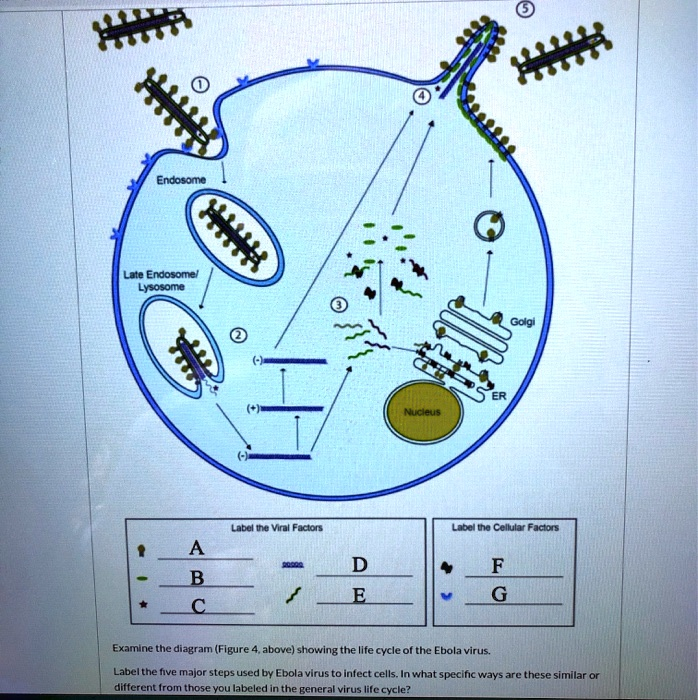
Endosome Late Endosome Lysosome Golgi Nucleus Lipid Inclusion Viral Factors Label Cellular Factors Examine the diagram (Figure above) showing the life cycle of the Ebola virus: Label the five major steps used by Ebola virus to infect cells. In what specific ways are these similar or different from those you labeled in the general virus life cycle?
The Correct Answer and Explanation is:
Correct Answer
Label the Viral Factors:
- A: Viral Glycoprotein
- B: Viral RNA
- C: Viral Nucleoprotein
- D: RNA-dependent RNA Polymerase
- E: Viral Matrix Protein
Label the Cellular Factors:
- F: Endoplasmic Reticulum (ER)
- G: Golgi Apparatus
Five Major Steps in the Ebola Virus Life Cycle
- Attachment and Entry:
The Ebola virus first attaches to the host cell surface through its glycoproteins (A), which bind to cellular receptors. This triggers endocytosis, allowing the virus to be engulfed into the host cell inside an endosome. - Fusion and Release:
Inside the endosome, the acidic environment facilitates fusion of the viral envelope with the endosomal membrane. The viral nucleocapsid (B and C) is released into the cytoplasm. - Replication and Transcription:
The viral RNA genome is transcribed and replicated by the RNA-dependent RNA polymerase (D). This process produces mRNAs that are translated into viral proteins and also synthesizes new copies of viral RNA. - Protein Translation and Assembly:
Viral proteins are synthesized in the cytoplasm and on the rough ER (F). The glycoproteins are processed in the ER and Golgi apparatus (G), then transported to the plasma membrane. New nucleocapsids assemble from viral RNA and nucleoproteins. - Budding and Release:
The completed viral particles migrate to the plasma membrane, where they bud off, taking a portion of the membrane with embedded viral glycoproteins. This forms the viral envelope, releasing new virions to infect other cells.
Comparison with General Virus Life Cycle
The Ebola virus life cycle shares common steps with most enveloped RNA viruses: attachment, entry, replication, assembly, and release. However, Ebola uses macropinocytosis—a specialized form of endocytosis—for cell entry, unlike some viruses that use direct membrane fusion. Additionally, Ebola’s replication occurs entirely in the cytoplasm, without nuclear involvement, unlike DNA viruses that often require nuclear entry. The unique processing of glycoproteins in the Golgi is also a characteristic aspect of the Ebola virus.