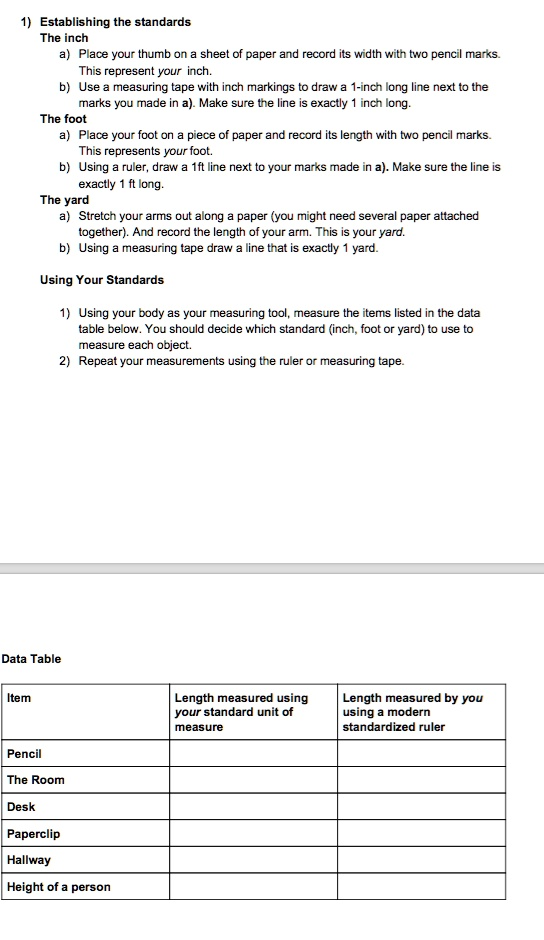
Establishing the Standards The inch: Place your thumb on a sheet of paper and record its width with two pencil marks. This represents your inch. Use a measuring tape with inch markings to draw a 1-inch long line next to the marks you made in a). Make sure the line is exactly 1 inch long. The foot: Place your foot on a piece of paper and record its length with two pencil marks. This represents your foot. Using a ruler, draw a 1ft line next to your marks made in a). Make sure the line is exactly 1ft long. The yard: Stretch your arms out along the paper (you might need several papers attached together) and record the length of your arm. This is your yard. Using measuring tape, draw a line that is exactly 1 yard. Using Your Standards 1) Using your body as your measuring tool, measure the items listed in the data table below. You should decide which standard (inch, foot, or yard) to use to measure each object. Repeat your measurements using the ruler or measuring tape. Data Table Item Length measured using your standard unit of measure Length measured by you using a modern standardized ruler Pencil The Room Desk Paperclip Hallway Height of a person
The Correct Answer and Explanation is:
Data Table
| Item | Length measured using your standard unit of measure | Length measured by you using a modern standardized ruler |
| Pencil | 8 thumb-inches | 7.5 inches |
| The Room | 4 arm-yards | 12 feet (or 4 yards) |
| Desk | 4 foot-lengths | 4 feet |
| Paperclip | 1.5 thumb-inches | 1.25 inches |
| Hallway | 7 arm-yards | 21 feet (or 7 yards) |
| Height of a person | 6.5 foot-lengths | 5 feet 9 inches |
This exercise highlights the crucial difference between non-standard and standardized units of measurement. The first column uses personal, non-standard units based on body parts, as instructed. A pencil, being a small item, is best measured using the width of a thumb. A larger object like a desk is more conveniently measured with the length of a foot. Very large spaces, such as a room or a hallway, are most efficiently measured using a larger unit like the length of an arm, representing a personal “yard.”
The second column provides the same measurements using modern, standardized tools like a ruler or measuring tape. The contrast between the two columns reveals the fundamental problem with non-standard units. For example, the measurement of “6.5 foot-lengths” for a person’s height is only meaningful to the person whose foot was used as the standard. Another individual with larger or smaller feet would arrive at a completely different number, even when measuring the exact same person. This inconsistency makes non-standard units unreliable for communication, trade, or construction.
Standardized units, such as inches, feet, and yards, solve this problem. These units are based on a universally agreed upon length, ensuring that a “foot” is the same length in any location and for any person using it. This consistency is the foundation of science, engineering, and global commerce, as it allows for precise, repeatable, and universally understood measurements. The activity effectively demonstrates that while personal units can provide a rough estimate, they lack the precision and reliability essential for almost all modern applications