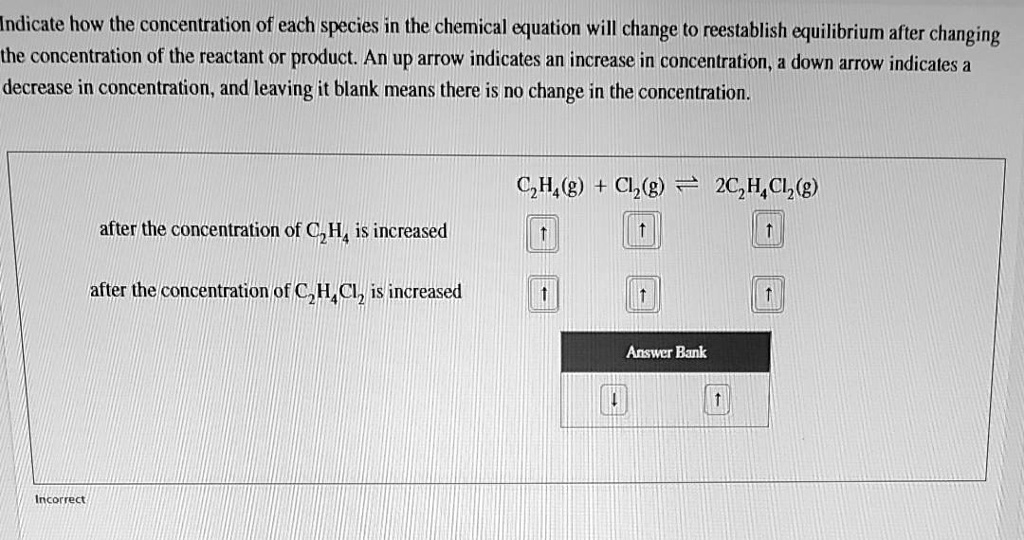
Indicate how the concentration of each species in the chemical equation will change to reestablish equilibrium after changing the concentration of the reactant or product: An up arrow indicates an increase in concentration, a down arrow indicates a decrease in concentration, and leaving it blank means there is no change in the concentration. C2H4(g) + Cl2(g) ⇌ 2C2H4Cl(g) After the concentration of C2H4 is increased: After the concentration of C2H4Cl2 is increased: Answer Book Uncorrected
The Correct Answer and Explanation is:
Of course. Here is the correctly filled-out table and a detailed explanation.
Correct Answer
Chemical Equation: C₂H₄(g) + Cl₂(g) ⇌ 2C₂H₄Cl₂(g)
| Condition | C₂H₄ | Cl₂ | 2C₂H₄Cl₂ |
| after the concentration of C₂H₄ is increased | ↑ | ↓ | ↑ |
| after the concentration of C₂H₄Cl₂ is increased | ↑ | ↑ | ↑ |
Explanation
This problem is governed by Le Châtelier’s Principle, which states that if a change (or “stress”) is applied to a system at equilibrium, the system will adjust itself to counteract the change and re-establish a new equilibrium. The stresses here are changes in the concentration of a reactant and a product.
Scenario 1: After the concentration of C₂H₄ is increased
- The Stress: The concentration of the reactant C₂H₄ is increased. This disrupts the existing equilibrium.
- The Shift: According to Le Châtelier’s Principle, the system will try to reduce the concentration of the added C₂H₄. It can do this by favoring the forward reaction, which consumes the reactants. Therefore, the equilibrium will shift to the right, towards the product side.
- The Result:
- C₂H₄: The system consumes C₂H₄ to shift right. However, the shift does not consume all of the C₂H₄ that was initially added. As a result, the new equilibrium concentration of C₂H₄ will be higher than it was in the original equilibrium. (↑)
- Cl₂: As the equilibrium shifts to the right, the other reactant, Cl₂, is also consumed. Its concentration will decrease. (↓)
- C₂H₄Cl₂: The forward reaction produces C₂H₄Cl₂. Therefore, its concentration will increase. (↑)
Scenario 2: After the concentration of C₂H₄Cl₂ is increased
- The Stress: The concentration of the product, C₂H₄Cl₂, is increased.
- The Shift: To counteract this stress, the system will favor the reaction that consumes the added product. This is the reverse reaction. Therefore, the equilibrium will shift to the left, towards the reactant side.
- The Result:
- C₂H₄Cl₂: The system consumes the product to shift left. However, just as in the first scenario, the shift does not consume all of the added C₂H₄Cl₂. The new equilibrium concentration of C₂H₄Cl₂ will be higher than its original concentration. (↑)
- C₂H₄: As the equilibrium shifts to the left, the reactant C₂H₄ is produced. Its concentration will increase. (↑)
- Cl₂: The other reactant, Cl₂, is also produced during the shift to the left. Its concentration will also increase. (↑)