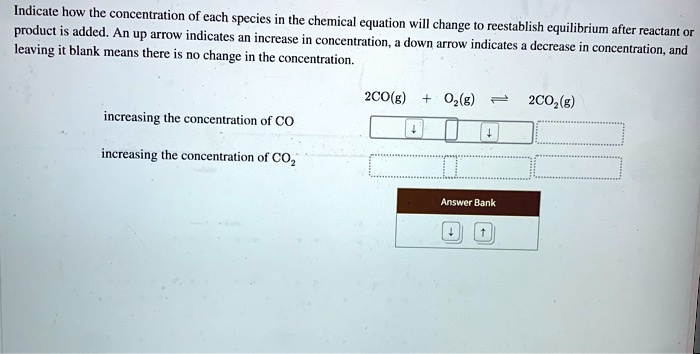
Indicate how the concentration of each species in the chemical equation will change to reestablish equilibrium after reactant or product is added. An up arrow indicates an increase in concentration, a down arrow indicates a decrease in concentration, and leaving it blank means there is no change in the concentration.
increasing the concentration of CO increasing the concentration of CO
Answer Bank
The Correct Answer and Explanation is:
Here are the correct answers indicating the change in concentration for each species, followed by a detailed explanation.
The chemical equation is: 2CO(g) + O₂(g) ⇌ 2CO₂(g)
| Condition | Change in [CO] | Change in [O₂] | Change in [CO₂] |
| increasing the concentration of CO | ↑ | ↓ | ↑ |
| increasing the concentration of CO₂ | ↑ | ↑ | ↑ |
Explanation
This problem is solved using Le Châtelier’s principle, which states that if a change (or stress) is applied to a system at equilibrium, the system will shift in a direction that partially counteracts the stress to establish a new equilibrium.
1. Increasing the concentration of CO
- Stress: The concentration of a reactant, carbon monoxide (CO), is increased.
- System’s Response: To counteract this stress, the system will shift to consume the added CO. This means the forward reaction is favored. The equilibrium shifts to the right.
- Concentration Changes:
- CO: The system is stressed by adding CO. Although the forward reaction consumes some CO to reach the new equilibrium, it does not consume all of the amount that was added. Therefore, the final concentration of CO at the new equilibrium will be higher (↑) than its original concentration.
- O₂: As the equilibrium shifts to the right, the other reactant, oxygen (O₂), is consumed. Its concentration will decrease (↓).
- CO₂: The shift to the right favors the formation of the product, carbon dioxide (CO₂). Its concentration will increase (↑).
2. Increasing the concentration of CO₂
- Stress: The concentration of the product, carbon dioxide (CO₂), is increased.
- System’s Response: To relieve this stress, the system will shift to consume the added CO₂. This means the reverse reaction is favored. The equilibrium shifts to the left.
- Concentration Changes:
- CO₂: Similar to the first scenario, the system is stressed by adding CO₂. The reverse reaction consumes some of the added CO₂, but the new equilibrium concentration will still be higher (↑) than the original concentration.
- CO: As the equilibrium shifts to the left, the reactant carbon monoxide (CO) is produced. Its concentration will increase (↑).
- O₂: The shift to the left also produces the reactant oxygen (O₂). Its concentration will also increase (↑).