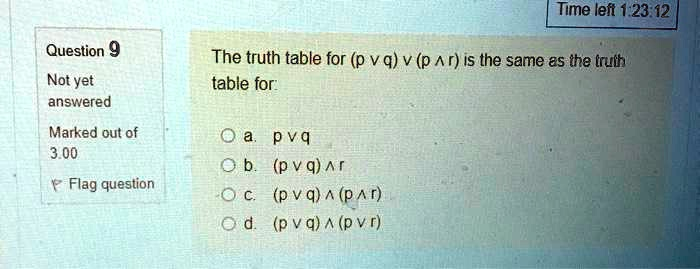
question The truth table for (p V q) v (p ∧ r) is the same as the truth table for: p v q ∧ (p ∧ q) ∧ (p ∧ r) ∧ (p v r)
Time left 1.23 * 12 Question 9 Not yet answered Marked out of 3 00 Flag question The truth table for (p V q) v (p ∧ r) is the same as the truth table for: p v q ∧ (p ∧ q) ∧ (p ∧ r) ∧ (p v r)
The Correct Answer and Explanation is:
The correct answer is a. p ∨ q.
Explanation
To determine which expression has the same truth table as (p ∨ q) ∨ (p ∧ r), we need to find a logically equivalent expression. This can be done by either using the laws of propositional logic to simplify the expression or by constructing and comparing truth tables.
Method 1: Using Laws of Propositional Logic
This is often the most direct method. The goal is to simplify the original expression: (p ∨ q) ∨ (p ∧ r).
- Original Expression: (p ∨ q) ∨ (p ∧ r)
- Apply the Associative and Commutative Laws: The ∨ (OR) operator is associative and commutative, which means we can reorder and regroup the terms. Let’s group the terms involving p together.
(p ∨ q) ∨ (p ∧ r) ≡ p ∨ q ∨ (p ∧ r) ≡ q ∨ (p ∨ (p ∧ r)) - Apply the Absorption Law: The Absorption Law states that A ∨ (A ∧ B) ≡ A. In the sub-expression p ∨ (p ∧ r), we can see this pattern where A = p and B = r. Therefore, the expression p ∨ (p ∧ r) simplifies to just p.
- Substitute and Final Simplification: Now we substitute this simplified part back into the expression from step 2:
q ∨ (p) - Using the Commutative Law, q ∨ p is equivalent to p ∨ q.
Thus, the original complex expression simplifies to p ∨ q, which matches option a.
Method 2: Using a Truth Table
We can verify this result by constructing a truth table for the original expression and for the simplified expression p ∨ q. If their final truth values are identical for all possible inputs, they are equivalent.
Let’s create the truth table for (p ∨ q) ∨ (p ∧ r):
| p | q | r | p ∨ q | p ∧ r | (p ∨ q) ∨ (p ∧ r) | p ∨ q |
| T | T | T | T | T | T | T |
| T | T | F | T | F | T | T |
| T | F | T | T | T | T | T |
| T | F | F | T | F | T | T |
| F | T | T | T | F | T | T |
| F | T | F | T | F | T | T |
| F | F | T | F | F | F | F |
| F | F | F | F | F | F | F |
As shown in the table, the final column for the original expression (p ∨ q) ∨ (p ∧ r) is identical to the column for p ∨ q. This confirms that they are logically equivalent. Therefore, they have the same truth table.thumb_upthumb_down