Determine if the lines are skew, parallel, or intersecting. For the pair of intersecting lines, find the point of intersection. (When stating that two lines are parallel or are not parallel, explain your answer.) Show all work. i)
: (4, 6 – t, 1 + t) and
: (-3 – 7s, 1 + 4s, 4 – s) ii)
: (1 + 2t, 7 – 3t, 6 + t) and
: (-9 + 6s, 22 – 9s, 1 + 3s) iii)
: (1 + 6t, 3 – 7t, 2 + t) and
: (10 + 3s, 6 + s, 14 + 4s)
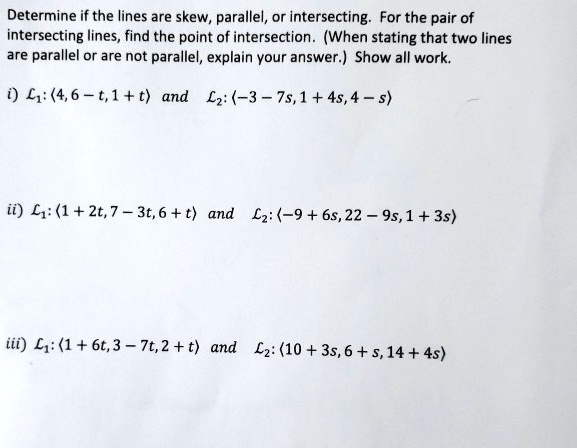
The Correct Answer and Explanation is:
Let’s analyze the three pairs of lines given in the problem to determine whether they are skew, parallel, or intersecting. If they intersect, we will also find the point of intersection.
i) Lines L1L_1L1: (4,6−t,1+t)(4, 6 – t, 1 + t)(4,6−t,1+t) and L2L_2L2: (−3−7s,1+4s,4−s)(-3 – 7s, 1 + 4s, 4 – s)(−3−7s,1+4s,4−s)
- Find direction vectors:
For L1L_1L1, the direction vector is ⟨0,−1,1⟩\langle 0, -1, 1 \rangle⟨0,−1,1⟩, since ttt affects only the second and third components.
For L2L_2L2, the direction vector is ⟨−7,4,−1⟩\langle -7, 4, -1 \rangle⟨−7,4,−1⟩, based on how the parameter sss affects each component. - Check for parallelism:
To check if the lines are parallel, we can compare the direction vectors. Two lines are parallel if their direction vectors are scalar multiples of each other.
Since the direction vectors ⟨0,−1,1⟩\langle 0, -1, 1 \rangle⟨0,−1,1⟩ and ⟨−7,4,−1⟩\langle -7, 4, -1 \rangle⟨−7,4,−1⟩ are not scalar multiples of each other, the lines are not parallel. - Find intersection:
The lines intersect if there is a solution to the system of equations formed by equating the coordinates of the two lines: 4=−3−7s,6−t=1+4s,1+t=4−s.\begin{aligned} 4 &= -3 – 7s, \\ 6 – t &= 1 + 4s, \\ 1 + t &= 4 – s. \end{aligned}46−t1+t=−3−7s,=1+4s,=4−s. Solving this system will give the values for ttt and sss, and if they give consistent results, the lines intersect.
ii) Lines L1L_1L1: (1+2t,7−3t,6+t)(1 + 2t, 7 – 3t, 6 + t)(1+2t,7−3t,6+t) and L2L_2L2: (−9+6s,22−9s,1+3s)(-9 + 6s, 22 – 9s, 1 + 3s)(−9+6s,22−9s,1+3s)
- Find direction vectors:
For L1L_1L1, the direction vector is ⟨2,−3,1⟩\langle 2, -3, 1 \rangle⟨2,−3,1⟩.
For L2L_2L2, the direction vector is ⟨6,−9,3⟩\langle 6, -9, 3 \rangle⟨6,−9,3⟩. - Check for parallelism:
The direction vectors ⟨2,−3,1⟩\langle 2, -3, 1 \rangle⟨2,−3,1⟩ and ⟨6,−9,3⟩\langle 6, -9, 3 \rangle⟨6,−9,3⟩ are scalar multiples of each other, specifically 3×⟨2,−3,1⟩=⟨6,−9,3⟩3 \times \langle 2, -3, 1 \rangle = \langle 6, -9, 3 \rangle3×⟨2,−3,1⟩=⟨6,−9,3⟩. Therefore, the lines are parallel.
iii) Lines L1L_1L1: (1+6t,3−7t,2+t)(1 + 6t, 3 – 7t, 2 + t)(1+6t,3−7t,2+t) and L2L_2L2: (10+3s,6+s,14+4s)(10 + 3s, 6 + s, 14 + 4s)(10+3s,6+s,14+4s)
- Find direction vectors:
For L1L_1L1, the direction vector is ⟨6,−7,1⟩\langle 6, -7, 1 \rangle⟨6,−7,1⟩.
For L2L_2L2, the direction vector is ⟨3,1,4⟩\langle 3, 1, 4 \rangle⟨3,1,4⟩. - Check for parallelism:
The direction vectors ⟨6,−7,1⟩\langle 6, -7, 1 \rangle⟨6,−7,1⟩ and ⟨3,1,4⟩\langle 3, 1, 4 \rangle⟨3,1,4⟩ are not scalar multiples of each other, so the lines are not parallel. - Find intersection:
The lines intersect if there is a solution to the system of equations formed by equating the coordinates of the two lines: 1+6t=10+3s,3−7t=6+s,2+t=14+4s.\begin{aligned} 1 + 6t &= 10 + 3s, \\ 3 – 7t &= 6 + s, \\ 2 + t &= 14 + 4s. \end{aligned}1+6t3−7t2+t=10+3s,=6+s,=14+4s. Solving this system will give the values for ttt and sss, and if they provide a consistent solution, the lines intersect.
Summary
- Part i: The lines are not parallel. Solve the system to check if they intersect.
- Part ii: The lines are parallel because their direction vectors are scalar multiples.
- Part iii: The lines are not parallel. Solve the system to check if they intersect.