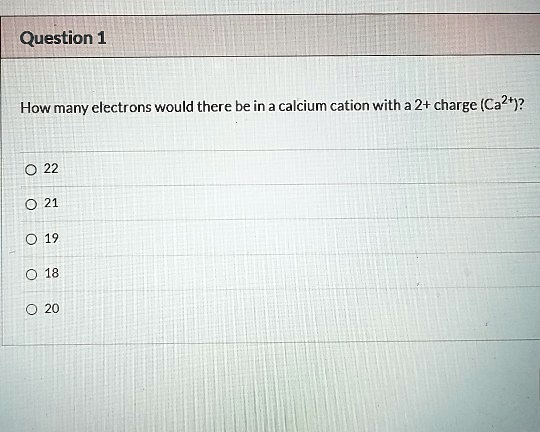
How many electrons would there be in a calcium cation with a 2+ charge (Ca2+)?
The Correct Answer and Explanation is:
The correct answer is 18.
To determine the number of electrons in a calcium cation with a 2+ charge (Ca²⁺), we must first understand the properties of a neutral calcium atom. We can find calcium (Ca) on the periodic table. Its atomic number is 20. The atomic number of an element signifies the number of protons in the nucleus of one of its atoms. In an electrically neutral atom, the number of negatively charged electrons is equal to the number of positively charged protons. Therefore, a neutral calcium atom has 20 protons and 20 electrons.
The question asks about a calcium cation with a 2+ charge. A cation is a positively charged ion that forms when a neutral atom loses one or more electrons. The charge of the ion indicates how many electrons have been lost. In this case, the “2+” charge on the calcium ion (Ca²⁺) means that a neutral calcium atom has lost two of its electrons.
We can calculate the number of electrons remaining in the ion by starting with the number of electrons in the neutral atom and subtracting the number of electrons that were lost.
Number of electrons in neutral Ca = 20
Number of electrons lost to form Ca²⁺ = 2
Number of electrons in Ca²⁺ = 20 – 2 = 18
Thus, a calcium cation with a 2+ charge has 18 electrons. This process of losing two electrons is common for calcium because it allows the atom to achieve a more stable electron configuration. By losing its two outermost valence electrons, the calcium ion is left with the same number of electrons as the noble gas Argon (Ar), which has a full and stable outer electron shell. This stability is the driving force behind the formation of the Ca²⁺ ion