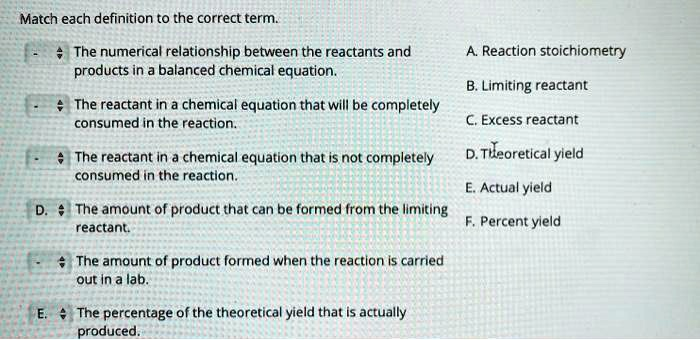
Match each definition to the correct term. The numerical relationship between the reactants and products in a balanced chemical equation. The reactant in a chemical equation that will be completely consumed in the reaction. The reactant in a chemical equation that is not completely consumed in the reaction. D. The amount of product that can be formed from the limiting reactant. The amount of product formed when the reaction is carried out in a lab. E. The percentage of the theoretical yield that is actually produced. A. Reaction stoichiometry B. Limiting reactant C. Excess reactant D. Theoretical yield E. Actual yield F. Percent yield
The Correct Answer and Explanation is:
Here are the correct matches for the definitions and terms provided:
- A. Reaction stoichiometry matches the definition: The numerical relationship between the reactants and products in a balanced chemical equation.
- B. Limiting reactant matches the definition: The reactant in a chemical equation that will be completely consumed in the reaction.
- C. Excess reactant matches the definition: The reactant in a chemical equation that is not completely consumed in the reaction.
- D. Theoretical yield matches the definition: The amount of product that can be formed from the limiting reactant.
- E. Actual yield matches the definition: The amount of product formed when the reaction is carried out in a lab.
- F. Percent yield matches the definition: The percentage of the theoretical yield that is actually produced.
Explanation of Terms
These terms are fundamental concepts in chemical stoichiometry, which is the study of the quantitative relationships in chemical reactions.
Reaction stoichiometry is the starting point. It involves using the coefficients from a balanced chemical equation to establish the exact mole ratios between reactants and products. This numerical relationship allows chemists to calculate how much product can be made from a certain amount of reactant, or how much reactant is needed to produce a specific amount of product.
In most real world reactions, reactants are not mixed in the perfect ratio prescribed by stoichiometry. This leads to the concepts of limiting and excess reactants. The limiting reactant is the substance that is completely used up first in the reaction. Because it runs out, it dictates, or limits, the maximum amount of product that can be formed. Conversely, the excess reactant is the substance that is not completely used up; there will be some of this reactant left over after the reaction has stopped.
The amount of product is described by three different types of “yields.” The theoretical yield is the maximum possible amount of product that can be created from the given amounts of reactants. This is a calculated value, determined by performing a stoichiometric calculation based on the amount of the limiting reactant. It represents an ideal outcome, assuming the reaction goes to completion perfectly.
In practice, the ideal is rarely achieved. The actual yield is the amount of product that is physically measured after the reaction has been performed in a laboratory setting. This amount is often less than the theoretical yield due to factors like incomplete reactions, side reactions producing unwanted products, or loss of product during collection and purification.
To measure the efficiency of a reaction, we calculate the percent yield. This value compares the actual yield to the theoretical yield and is calculated using the formula: (Actual Yield / Theoretical Yield) × 100%. A high percent yield indicates an efficient reaction, while a low percent yield suggests significant product loss or reaction inefficiency