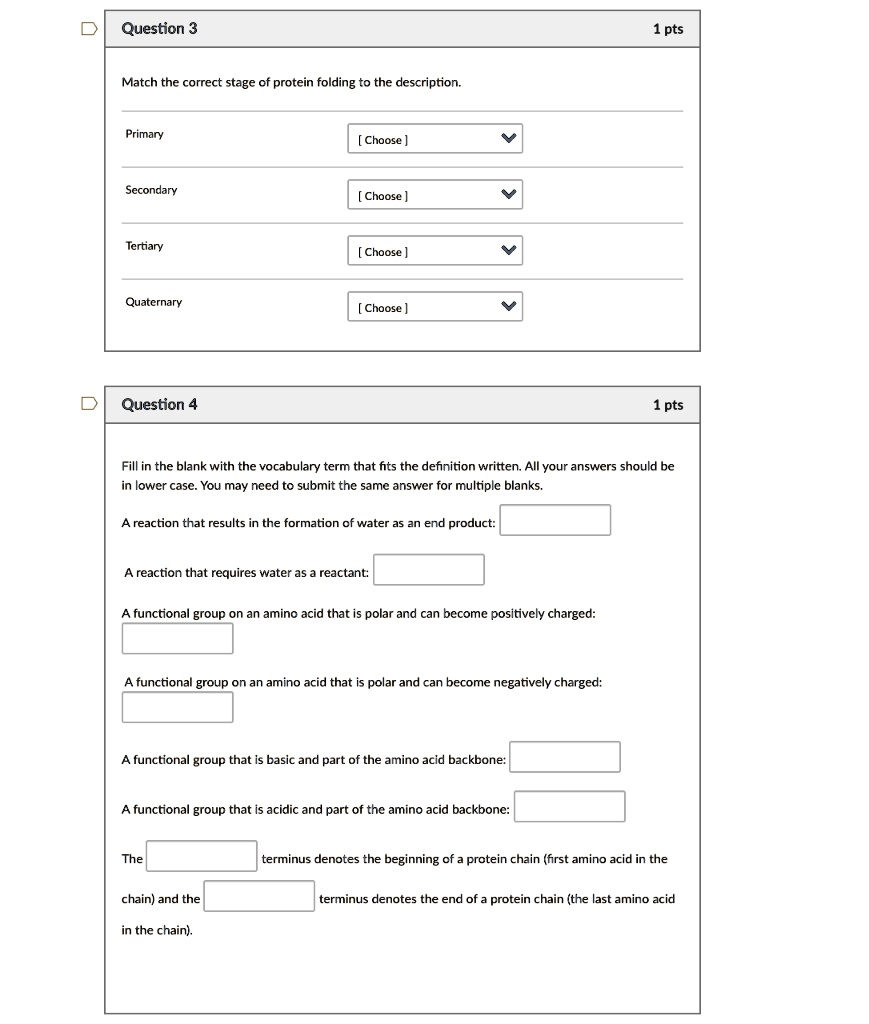
Match the correct stage of protein folding to the description. Primary Secondary [Choose] [Choose] Tertiary [Choose] Quaternary [Choose] Question 4 1 pts 1 pts Fill in the blank with the vocabulary term that fits the definition written. All your answers should be in lower case. You may need to submit the same answer for multiple blanks. A reaction that results in the formation of water as an end product: A reaction that requires water as a reactant: A functional group on an amino acid that is polar and can become positively charged: A functional group on an amino acid that is polar and can become negatively charged: A functional group that is basic and part of the amino acid backbone: A functional group that is acidic and part of the amino acid backbone: The chain) and the in the chain). terminus denotes the beginning of a protein chain (first amino acid in the terminus denotes the end of a protein chain (the last amino acid
The Correct Answer and Explanation is:
It is not possible to answer Question 3, as the descriptions for matching the stages of protein folding (Primary, Secondary, Tertiary, Quaternary) are missing from the image provided.
Here are the answers for Question 4:
A reaction that results in the formation of water as an end product: dehydration
A reaction that requires water as a reactant: hydrolysis
A functional group on an amino acid that is polar and can become positively charged: amino group
A functional group on an amino acid that is polar and can become negatively charged: carboxyl group
A functional group that is basic and part of the amino acid backbone: amino group
A functional group that is acidic and part of the amino acid backbone: carboxyl group
The n-terminus terminus denotes the beginning of a protein chain (first amino acid in the chain) and the c-terminus terminus denotes the end of a protein chain (the last amino acid in the chain).
Explanation
The answers to Question 4 relate to the fundamental principles of protein and amino acid chemistry.
A dehydration reaction, also known as condensation, is a chemical process where two molecules, such as amino acids, are joined together by a covalent bond, resulting in the removal of a water molecule. This is how monomers link to form polymers like proteins. Conversely, hydrolysis is the opposite reaction. It involves the addition of a water molecule to break a covalent bond, splitting a polymer back into its constituent monomers. This is how proteins are broken down during digestion.
Every amino acid has a central carbon atom bonded to four different components: a hydrogen atom, a variable side chain (R-group), an amino group, and a carboxyl group. The amino group (–NH2) acts as a base because it can accept a proton (H+) from the surrounding solution, becoming positively charged (–NH3+). The carboxyl group (–COOH) acts as an acid because it can donate a proton, becoming negatively charged (–COO-). These two functional groups are key components of the amino acid backbone and are responsible for forming the peptide bonds that link amino acids together.
When amino acids join to form a polypeptide chain, they do so in a specific orientation. This gives the protein a defined directionality. The beginning of the chain, which has a free amino group, is called the n-terminus (amino-terminus). The end of the chain, which has a free carboxyl group, is called the c-terminus (carboxyl-terminus). By convention, protein sequences are always written from the n-terminus to the c-terminus, reflecting the direction of protein synthesis in the cell.