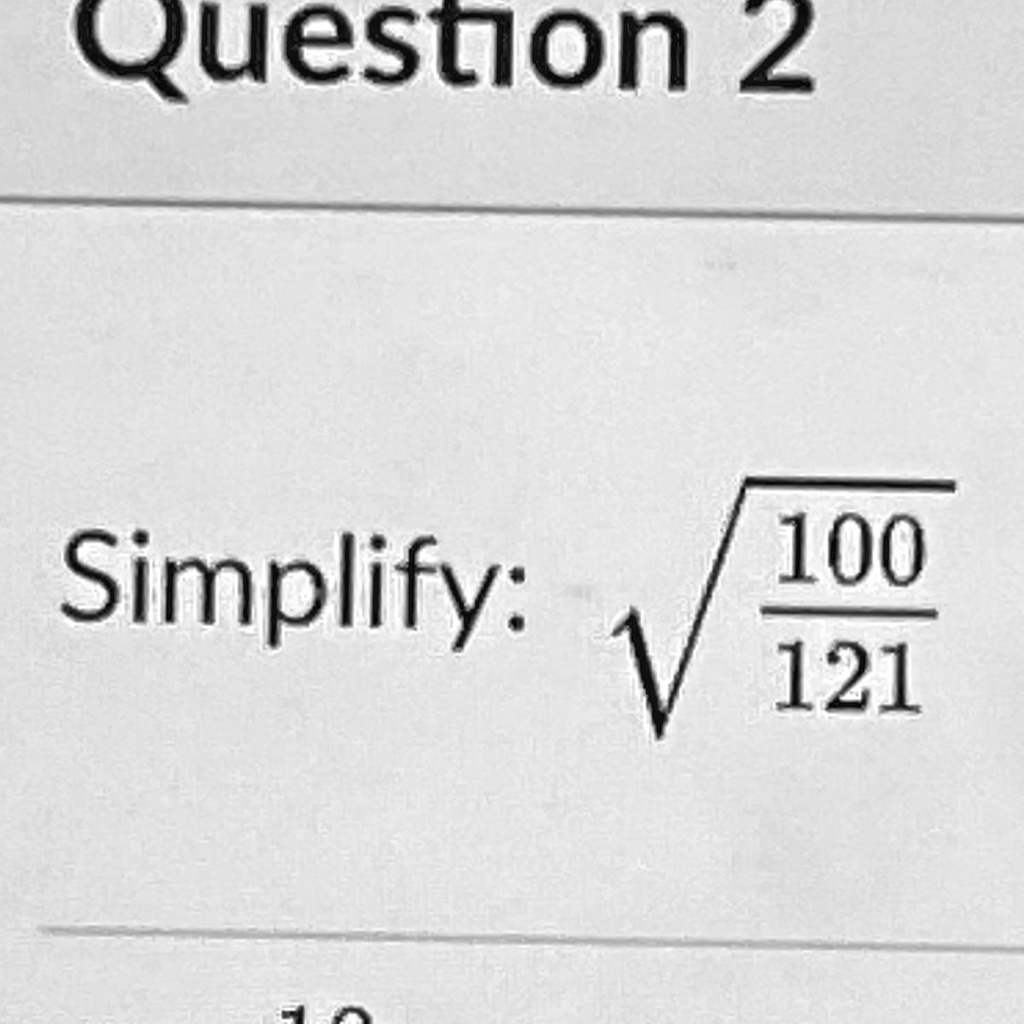
The Correct Answer and Explanation is:
The correct answer is 10/11.
The problem asks to simplify the expression which is the square root of the fraction 100 over 121, written as √(100/121). To solve this, we can use a key property of square roots known as the quotient rule for radicals. This rule allows us to distribute the square root operation to both the numerator and the denominator of the fraction individually. The formula for this rule is √(a/b) = (√a) / (√b).
By applying this rule to our specific problem, we can rewrite √(100/121) as √100 / √121. This step effectively breaks the original problem down into two simpler parts: finding the square root of the numerator and finding the square root of the denominator.
First, let’s address the numerator, √100. We are looking for a number that, when multiplied by itself, equals 100. Since 10 multiplied by 10 (10 × 10) is 100, the square root of 100 is 10. Numbers like 100, which have a whole number as their square root, are called perfect squares.
Next, we evaluate the denominator, √121. Similarly, we need to find the number that, when multiplied by itself, results in 121. Through basic multiplication, we find that 11 multiplied by 11 (11 × 11) equals 121. Therefore, the square root of 121 is 11. The number 121 is also a perfect square.
Now that we have simplified both parts, we can substitute these values back into our fraction. The √100 becomes 10, and the √121 becomes 11. This gives us the final fraction 10/11.
As a final check, we determine if the fraction 10/11 can be simplified further. A fraction is in its simplest form if the numerator and denominator share no common factors other than 1. Since 11 is a prime number, its only factors are 1 and 11. The number 10 is not divisible by 11, so the fraction cannot be reduced. Thus, the simplified form of √(100/121) is 10/11.