What is the IUPAC name for the molecule shown
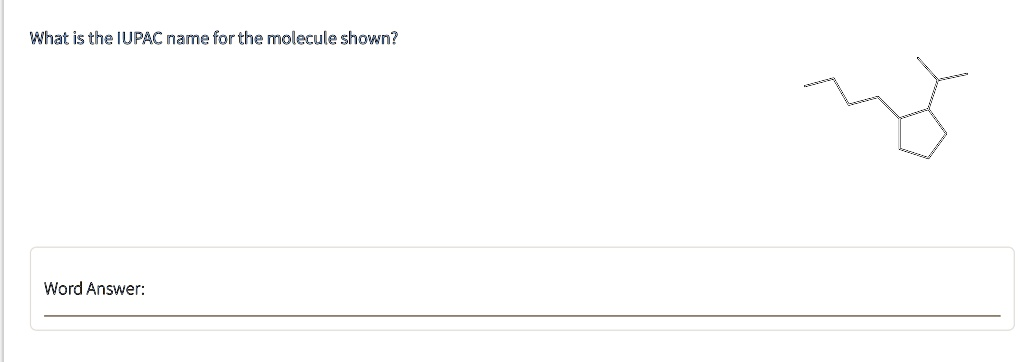
The Correct Answer and Explanation is:
The correct IUPAC name for the molecule shown is:
1-butyl-2-isopropylcyclopentane
Explanation:
To determine the IUPAC name for this molecule, we follow a set of systematic rules:
- Identify the Parent Hydrocarbon: The main structure of the molecule is a five-membered ring of carbon atoms connected by single bonds. A five-carbon ring is named cyclopentane. This serves as the base name for the molecule.
- Identify the Substituents: There are two alkyl groups attached to the cyclopentane ring.
- One is a straight-chain group with four carbon atoms (–CH₂CH₂CH₂CH₃). This is a butyl group.
- The other is a branched three-carbon group attached by its middle carbon (–CH(CH₃)₂). This is an isopropyl group.
- Number the Ring Carbons: For cycloalkanes with multiple substituents, we need to number the carbons in the ring to give the substituents the lowest possible locants (position numbers). The numbering priority is determined by the alphabetical order of the substituents.
- “Butyl” comes before “isopropyl” alphabetically.
- Therefore, the carbon atom where the butyl group is attached is assigned position 1.
- Determine the Direction of Numbering: After assigning position 1, we number the rest of the ring in the direction that gives the next substituent the lowest possible number.
- If we number clockwise from the butyl group, the isopropyl group is at position 5.
- If we number counter-clockwise, the isopropyl group is at position 2.
- Since 2 is a lower number than 5, we use the counter-clockwise numbering. The locants for the substituents are 1 and 2.
- Assemble the Full Name: The final IUPAC name is constructed by listing the substituents in alphabetical order, each preceded by its locant number and a hyphen. The substituent names are placed before the parent name.
- Alphabetical order: butyl, then isopropyl.
- Locants: 1 for butyl, 2 for isopropyl.
- Parent name: cyclopentane.
Combining these parts gives the final name: 1-butyl-2-isopropylcyclopentane