) What is the mass number of an atom that contains 31 protons, 36 neutrons, and 31 electrons? mass number = (2) What is the symbol for the element? element =
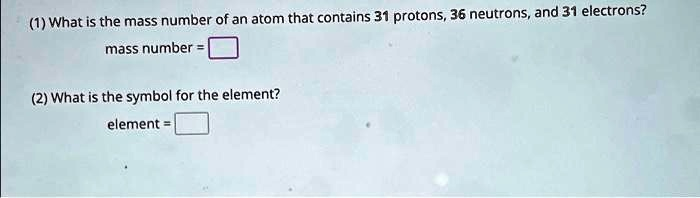
The Correct Answer and Explanation is:
mass number = 67
element = Ga
Here is a detailed explanation for each answer:
1. Calculating the Mass Number
The mass number of an atom, represented by the symbol A, is the total number of protons and neutrons found within the atom’s nucleus. These two particles, protons and neutrons, account for nearly all of the atom’s mass. The formula to find the mass number is:
Mass Number (A) = Number of Protons + Number of Neutrons
In this problem, we are given the following information:
- Number of protons = 31
- Number of neutrons = 36
Plugging these values into the formula, we get:
Mass Number = 31 + 36 = 67
Therefore, the mass number of this atom is 67. The number of electrons, which is 31, is not used to calculate the mass number. Electrons are located outside the nucleus and have a mass so small that it is considered negligible when determining the mass number.
2. Identifying the Element Symbol
The identity of a chemical element is determined solely by its atomic number, represented by the symbol Z. The atomic number is equal to the number of protons in the nucleus of an atom. Each element has a unique number of protons.
For this atom, we are told it contains 31 protons. This means its atomic number is 31. To find the element, we look at the periodic table for the element with an atomic number of 31.
The element with atomic number 31 is Gallium. The chemical symbol for Gallium is Ga.
The number of neutrons (36) tells us that this specific atom is an isotope known as Gallium-67. The fact that the atom has 31 electrons, the same as the number of protons, indicates that it is electrically neutral, not an ion. However, for identifying the element itself, only the number of protons is necessary