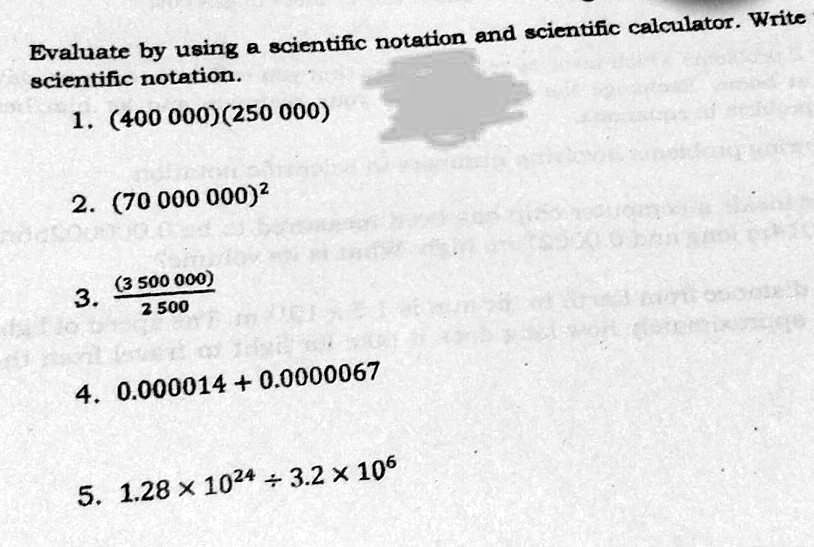
Evaluate by using a scientific notation and scientific calculator. Write scientific notation. 1. (400 000)(250 000) 2. (70 000 000)
- 0.000014 + 0.0000067 5. 1.28 x 10
÷ 3.2 x 10
Here are the correct answers and a detailed explanation for each problem.
Correct Answers:
- 1 x 10¹¹
- 4.9 x 10¹⁵
- 1.4 x 10³
- 2.07 x 10⁻⁵
- 4 x 10¹⁷
Explanation
Scientific notation is a method for writing very large or very small numbers as a product of a coefficient (a number between 1 and 10) and a power of 10. The process involves converting numbers into this format, performing the calculation, and then ensuring the final answer is also in proper scientific notation.
1. (400,000)(250,000)
First, we convert both numbers to scientific notation. 400,000 is 4 x 10⁵ and 250,000 is 2.5 x 10⁵. To multiply these, we multiply the coefficients (4 × 2.5 = 10) and add the exponents (5 + 5 = 10). This gives us 10 x 10¹⁰. Since the coefficient must be less than 10, we adjust it. 10 can be written as 1 x 10¹, so the expression becomes (1 x 10¹) x 10¹⁰. Adding the new exponents gives the final answer: 1 x 10¹¹.
2. (70,000,000)²
We begin by writing 70,000,000 in scientific notation, which is 7 x 10⁷. To square this number, we square the coefficient (7² = 49) and multiply the exponent by 2 (10⁷)² = 10¹⁴. The result is 49 x 10¹⁴. We must adjust the coefficient 49 to 4.9 x 10¹. The expression is now (4.9 x 10¹) x 10¹⁴. Adding the exponents (1 + 14 = 15) gives the final answer: 4.9 x 10¹⁵.
3. (3,500,000) / 2,500
Convert the numerator and denominator to scientific notation: 3.5 x 10⁶ and 2.5 x 10³. To divide, we divide the coefficients (3.5 ÷ 2.5 = 1.4) and subtract the exponents (6 – 3 = 3). The result is already in proper scientific notation: 1.4 x 10³.
4. 0.000014 + 0.0000067
The numbers in scientific notation are 1.4 x 10⁻⁵ and 6.7 x 10⁻⁶. To add them, their exponents must be the same. Let’s change 6.7 x 10⁻⁶ to 0.67 x 10⁻⁵. Now we can add the coefficients: 1.4 + 0.67 = 2.07. The exponent remains the same. The answer is 2.07 x 10⁻⁵.
5. 1.28 x 10²⁴ ÷ 3.2 x 10⁶
For this division, we divide the coefficients (1.28 ÷ 3.2 = 0.4) and subtract the exponents (24 – 6 = 18). This gives 0.4 x 10¹⁸. The coefficient 0.4 is less than 1, so we rewrite it as 4 x 10⁻¹. The expression becomes (4 x 10⁻¹) x 10¹⁸. Adding the exponents (-1 + 18 = 17) results in the final answer: 4 x 10¹⁷