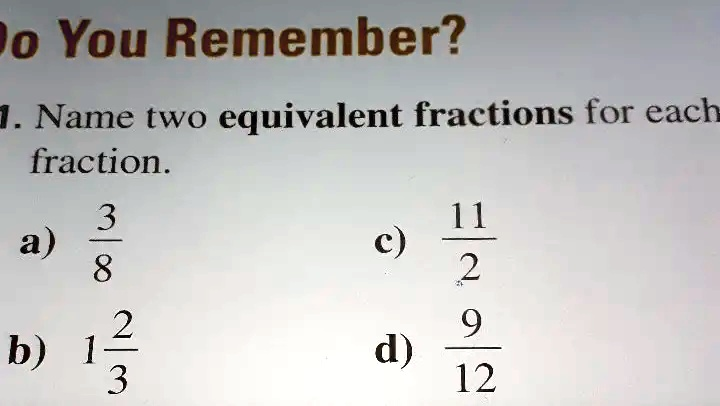
Do You Remember? 1. Name two equivalent fractions for each fraction. 3 11 a) \frac{3}{8} c) \frac{11}{2} 2 9 b) 1\frac{2}{3} d) \frac{9}{12}
The Correct Answer and Explanation is:
Of course. Here are the answers and a detailed explanation for the math problems.
Correct Answers
Note that many correct answers are possible. Here are some examples:
- a) For 3/8: Two equivalent fractions are 6/16 and 9/24.
- b) For 1 2/3: Two equivalent fractions are 10/6 and 15/9.
- c) For 11/2: Two equivalent fractions are 22/4 and 33/6.
- d) For 9/12: Two equivalent fractions are 3/4 and 18/24.
Explanation
Equivalent fractions are fractions that look different but represent the exact same value. The fundamental principle for finding an equivalent fraction is to multiply or divide both the numerator (the top number) and the denominator (the bottom number) by the same non-zero number. This method works because when you multiply or divide by a fraction like 2/2, 3/3, or 4/4, you are essentially multiplying or dividing by 1, which does not change the fraction’s actual value.
For problem a) 3/8, we can find equivalent fractions by multiplication. If we multiply both the numerator and denominator by 2, we get (3 × 2) / (8 × 2), which equals 6/16. If we multiply them by 3, we get (3 × 3) / (8 × 3), resulting in 9/24.
For problem b) 1 2/3, the first step is to convert this mixed number into an improper fraction. To do this, multiply the whole number (1) by the denominator (3) and add the numerator (2). This gives us 5. The denominator remains 3, so the improper fraction is 5/3. Now we can find equivalent fractions for 5/3. Multiplying by 2 gives us 10/6, and multiplying by 3 gives us 15/9.
For problem c) 11/2, we apply the same multiplication rule. Multiplying the numerator and denominator by 2 gives us (11 × 2) / (2 × 2), which is 22/4. Multiplying by 3 gives us (11 × 3) / (2 × 3), or 33/6.
Problem d) 9/12 offers a chance to use both division and multiplication. We can simplify this fraction by finding a common factor for 9 and 12, which is 3. Dividing both parts by 3 gives us (9 ÷ 3) / (12 ÷ 3), which equals 3/4. This is an equivalent fraction in its simplest form. For a second equivalent fraction, we can multiply the original 9/12 by 2 to get 18/24.