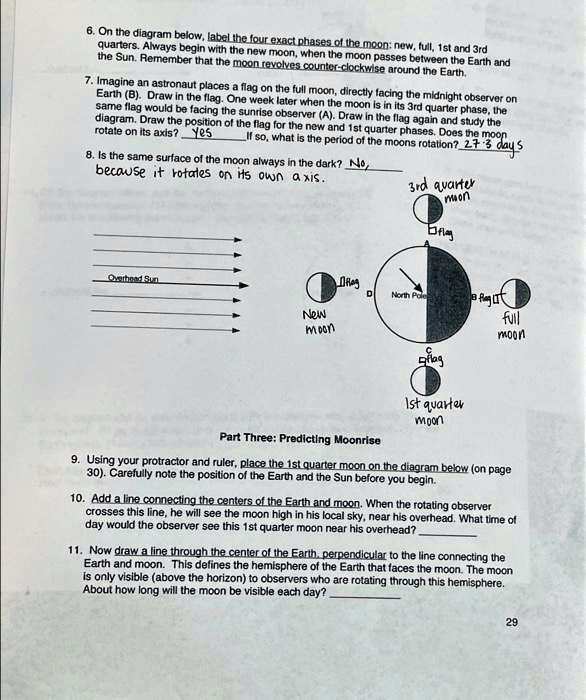
On the diagram below, label the four exact phases of the moon: new, full, 1st and 3rd quarters. Always begin with the new moon, when the moon passes between the Earth and the Sun. Remember that the moon revolves counter-clockwise around the Earth. 7. Imagine an astronaut places a flag on the full moon, directly facing the midnight observer on Earth (B). Draw in the flag. One week later when the moon is in its 3rd quarter phase, the same flag would be facing the sunrise observer (A). Draw in the flag again and study the diagram. Draw the position of the flag for the new and 1st quarter phases. Does the moon rotate on its axis? Yes If so, what is the period of the moons rotation? 27-3 days 8. Is the same surface of the moon always in the dark? No, because it rotates on its own axis. 3rd quarter moon Overhead Sun New moon flag D North Pole full moon flag 1st quarter moon Part Three: Predicting Moonrise 9. Using your protractor and ruler, place the 1st quarter moon on the diagram below (on page 30). Carefully note the position of the Earth and the Sun before you begin. 10. Add a line connecting the centers of the Earth and moon. When the rotating observer crosses this line, he will see the moon high in his local sky, near his overhead. What time of day would the observer see this 1st quarter moon near his overhead? 11. Now draw a line through the center of the Earth, perpendicular to the line connecting the Earth and moon. This defines the hemisphere of the Earth that faces the moon. The moon is only visible (above the horizon) to observers who are rotating through this hemisphere. About how long will the moon be visible each day? 29
Here are the correct answers and the explanation for the questions in “Part Three: Predicting Moonrise.”
Correct Answers
- 10. An observer would see the 1st quarter moon near their overhead around 6 PM or sunset.
- 11. The moon will be visible each day for about 12 hours.
Explanation
To understand these answers, we must analyze the relationship between the Sun’s position, the Earth’s rotation, and the Moon’s orbital position.
For question 10, we need to determine the time of day when the 1st quarter moon is highest in the sky. The diagram shows the Sun’s light coming from the left. An observer on Earth experiences different times of day based on their position relative to the Sun. Noon occurs when the observer is directly facing the Sun. Sunset, which is roughly 6 PM, happens when the observer has rotated 90 degrees away from the Sun. Midnight is when the observer is on the side of Earth directly opposite the Sun. Sunrise, or 6 AM, is when the observer rotates back into the sunlight.
The 1st quarter moon occurs when the Moon has completed one quarter of its orbit counter clockwise from the new moon position. This places it at a 90 degree angle to the line connecting the Earth and Sun. For an observer to see this moon directly overhead, they must be standing at a point on Earth’s surface that is directly under the moon. On the diagram, this position corresponds to the sunset location. Therefore, an observer would see the 1st quarter moon high in their local sky around 6 PM.
For question 11, we calculate the duration the moon is visible. The Earth completes a full rotation on its axis in about 24 hours. Because of this rotation, any celestial object, including the moon, is visible only from the hemisphere of the Earth that is facing it. An observer on the surface rotates into this hemisphere at moonrise and rotates out of it at moonset. This means the moon is above the horizon, and thus visible, for approximately half of Earth’s rotational period. Half of a 24 hour day is 12 hours. Following our example, if the 1st quarter moon is at its highest point at 6 PM, it would have risen about six hours earlier at noon and will set six hours later at midnight, resulting in a total visibility time of 12 hours.