Reteaching and Practice UNIDA present tense mirar escribir venir tener decir comer poner filmar recibir llorar dormir aprender salir estudiar No N M No N N N N No a No s No
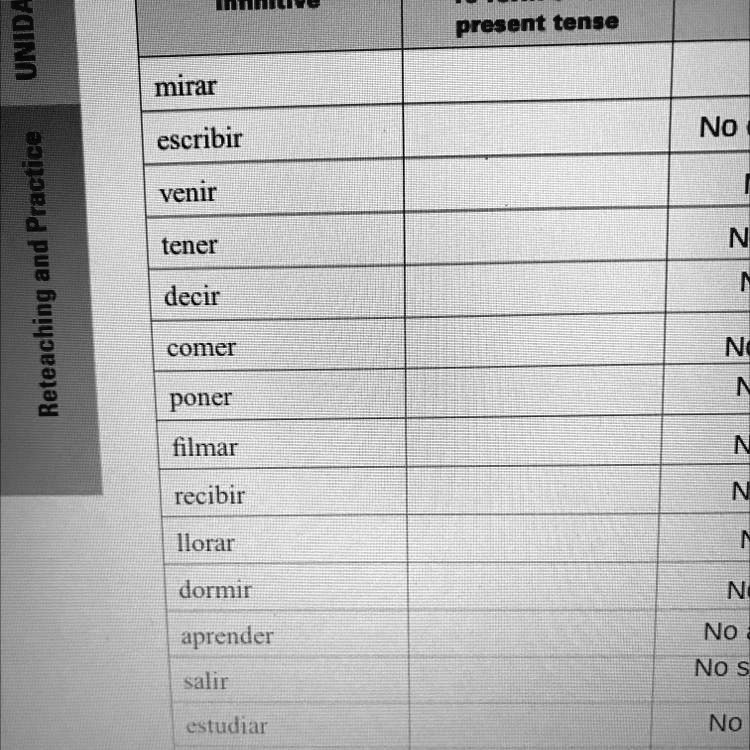
\The Correct Answer and Explanation is:
Of course. Here are the correct answers for the worksheet, followed by a detailed explanation.
Correct Answers
Here are the Spanish verbs from the list conjugated in the first-person singular (yo) form of the present tense:
- mirar — miro
- escribir — escribo
- venir — vengo
- tener — tengo
- decir — digo
- comer — como
- poner — pongo
- filmar — filmo
- recibir — recibo
- llorar — lloro
- dormir — duermo
- aprender — aprendo
- salir — salgo
- estudiar — estudio
Explanation
This exercise focuses on conjugating Spanish verbs into the first-person singular (yo) form of the present tense. This tense is used to describe current actions or habits. Mastering the yo form involves understanding the rules for regular verbs and memorizing the forms for common irregular verbs.
1. Regular Verbs (-ar, -er, and -ir)
For the majority of Spanish verbs, a simple, consistent rule applies. To conjugate a regular verb in the yo form, you drop the infinitive ending (the last two letters: -ar, -er, or -ir) and add the ending -o.
- -ar verbs: mirar → mir- → miro (I watch). Other regular -ar verbs on the list are filmar (filmo), llorar (lloro), and estudiar (estudio).
- -er verbs: comer → com- → como (I eat). aprender (aprendo) follows this same pattern.
- -ir verbs: escribir → escrib- → escribo (I write). recibir (recibo) is another regular -ir verb.
2. Irregular Verbs
Several important verbs are irregular, meaning they don’t follow the standard pattern. Many of these irregularities are specific to the yo form.
- “Go” Verbs: A common group of irregular verbs ends in -go in the yo form. This worksheet includes several key examples:
- tener (to have) → tengo
- venir (to come) → vengo
- decir (to say/tell) → digo
- poner (to put/place) → pongo
- salir (to leave/go out) → salgo
These verbs are only irregular in this specific way for the yo form; their other conjugations follow different patterns.
- Stem-Changing Verbs: Some verbs have a vowel change in their stem. dormir (to sleep) is an example of an o → ue stem change. This change applies to most present tense forms, including the yo form. Therefore, the o in dorm- changes to ue, resulting in duermo.