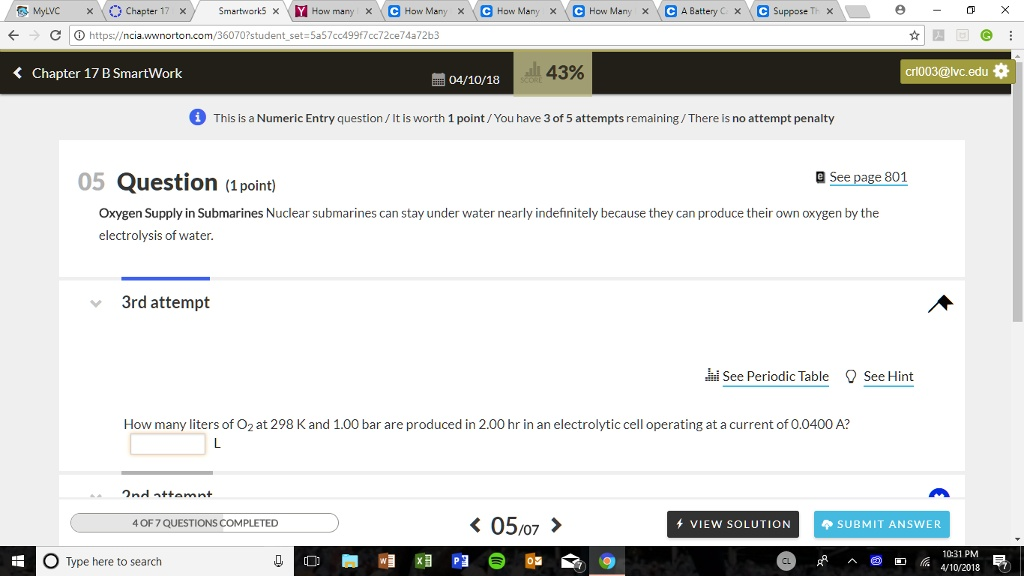
MyLVC X Chapter 17 X Smartwork5 X Y How many X How Many X ??C https://ncia.wwnorton.com/36070?student_set=5a57cc499f7cc72ce74a72b3 < Chapter 17 B SmartWork How Many X How Many X A Battery C. XC Suppose Th X e 43% 04/10/18 This is a Numeric Entry question / It is worth 1 point/You have 3 of 5 attempts remaining / There is no attempt penalty 05 Question (1 point) See page 801 Oxygen Supply in Submarines Nuclear submarines can stay under water nearly indefinitely because they can produce their own oxygen by the electrolysis of water. 3rd attempt [email protected] See Periodic Table See Hint How many liters of O2 at 298 K and 1.00 bar are produced in 2.00 hr in an electrolytic cell operating at a current of 0.0400 A? L 2nd attempt 4 OF 7 QUESTIONS COMPLETED Type here to search < 05/07 > + VIEW SOLUTION SUBMIT ANSWER 10:31 PM 4/10/2018
The Correct Answer and Explanation is:
Correct Answer: 0.0185
Explanation:
To determine the volume of oxygen gas produced, we must first find the number of moles of oxygen generated through electrolysis and then use the ideal gas law to convert moles into volume under the specified conditions.
Step 1: Calculate the total electrical charge.
The total charge (q) that passes through the electrolytic cell can be calculated by multiplying the current (I) by the time (t). The current is given as 0.0400 Amperes (A), which is equivalent to 0.0400 Coulombs per second (C/s). The time is 2.00 hours, which needs to be converted into seconds.
Time (t) = 2.00 hr × (3600 s / 1 hr) = 7200 s
Total Charge (q) = I × t = (0.0400 C/s) × (7200 s) = 288 C
Step 2: Calculate the moles of electrons.
Using Faraday’s constant (F ≈ 96,485 C/mol e⁻), we can convert the total charge into the number of moles of electrons (n_e) that were transferred during the process.
Moles of electrons (n_e) = q / F = 288 C / 96,485 C/mol e⁻ ≈ 0.002985 mol e⁻
Step 3: Relate moles of electrons to moles of oxygen.
The electrolysis of water produces oxygen gas at the anode according to the following half reaction:
2H₂O(l) → O₂(g) + 4H⁺(aq) + 4e⁻
This balanced equation shows that for every 1 mole of O₂ gas produced, 4 moles of electrons are transferred. We can use this stoichiometric ratio to find the moles of O₂ (n_O₂).
Moles of O₂ (n_O₂) = 0.002985 mol e⁻ × (1 mol O₂ / 4 mol e⁻) ≈ 0.0007462 mol O₂
Step 4: Calculate the volume of oxygen using the Ideal Gas Law.
Finally, we use the ideal gas law, PV = nRT, to find the volume of the oxygen gas. We rearrange the formula to solve for volume (V).
V = nRT / P
Given:
n = 0.0007462 mol
R (gas constant) = 0.08314 L·bar/(mol·K)
T (temperature) = 298 K
P (pressure) = 1.00 bar
V = (0.0007462 mol × 0.08314 L·bar/(mol·K) × 298 K) / 1.00 bar ≈ 0.01849 L
Rounding to three significant figures, the volume is 0.0185 L