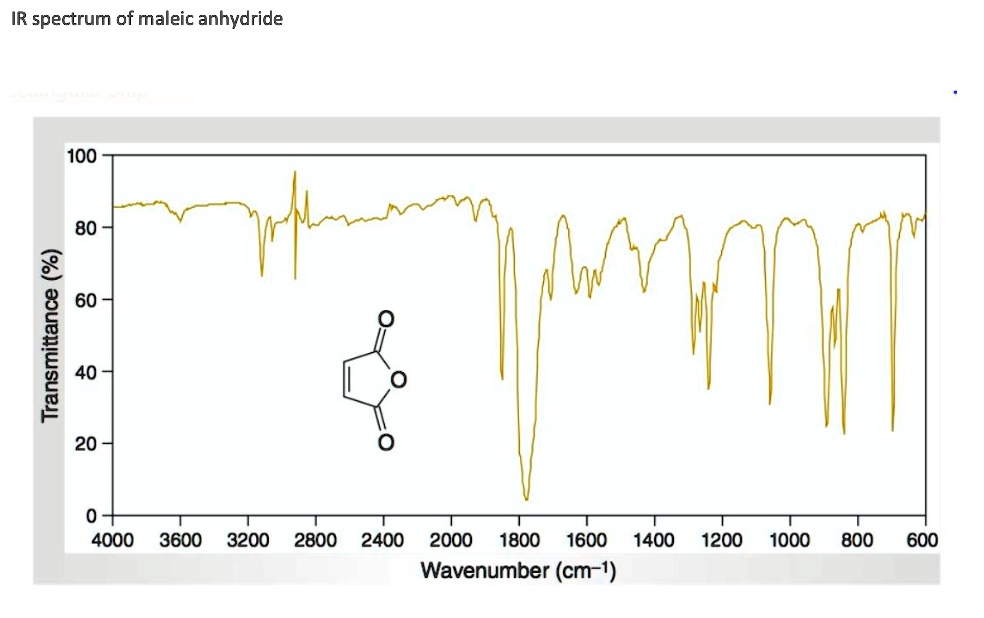
IR spectrum of maleic anhydride 100 80 2 60 L 40 20 4000 3600 3200 2800 2400 2000 1800 1600 1400 1200 1000 800 Wavenumber (cm-1) 600
The Correct Answer and Explanation is:
This IR spectrum provides a definitive fingerprint for the molecule maleic anhydride, confirming its structure through several key absorption bands corresponding to its functional groups.
The most diagnostic feature in the spectrum is the pair of very strong, sharp peaks in the carbonyl region. The peak at the higher wavenumber, approximately 1850 cm⁻¹, is due to the asymmetric stretching vibration of the two C=O groups. The corresponding peak at a lower wavenumber, around 1780 cm⁻¹, is assigned to the symmetric C=O stretching vibration. This characteristic two-peak pattern is the hallmark of an anhydride functional group. The frequencies are typical for a conjugated, five-membered cyclic anhydride, where ring strain slightly increases the frequency while conjugation with the double bond slightly lowers it.
Moving to higher wavenumbers, the sharp, medium-intensity peak observed around 3120 cm⁻¹ is characteristic of a vinylic C-H stretch (an sp²-hybridized carbon bonded to a hydrogen). The presence of this absorption and the notable absence of any peaks just below 3000 cm⁻¹ (where sp³ C-H stretches would appear) confirms the unsaturated nature of the molecule and the lack of any alkyl groups.
The C=C double bond stretch is also expected for this molecule, typically in the 1600–1650 cm⁻¹ region. In this spectrum, this absorption is likely the very weak peak or shoulder observed near 1600 cm⁻¹, its low intensity being common for relatively symmetrical double bonds.
Finally, the fingerprint region (below 1500 cm⁻¹) contains several strong absorptions. The prominent band around 1250 cm⁻¹ can be assigned to the C-O-C stretching vibration within the anhydride ring. Other strong peaks in this region, such as those near 1060 cm⁻¹ and 890 cm⁻¹, are related to complex C-H bending and other skeletal vibrations. In summary, the combination of the anhydride C=O doublet, the vinylic C-H stretch, and the C-O-C stretch provides conclusive evidence for the structure of maleic anhydride