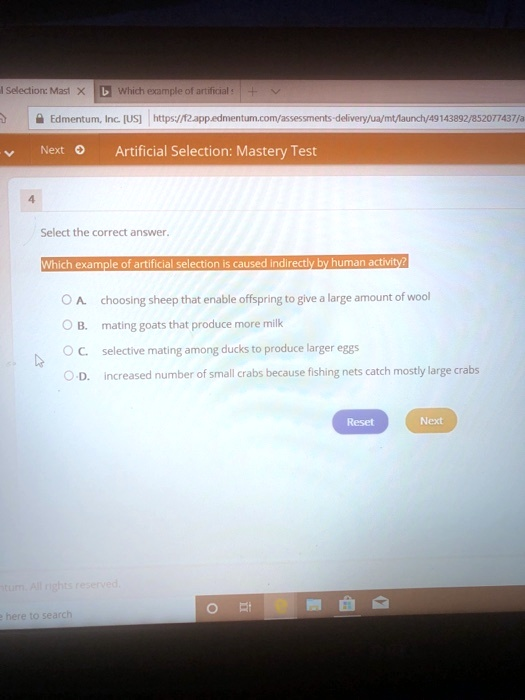
Selection: Mast X Which example of artificials + Edmentum, Inc. [US] https://f2.app.edmentum.com/assessments-delivery/ua/mt/launch/49143892/852077437/a Next Artificial Selection: Mastery Test 4 Select the correct answer. Which example of artificial selection is caused indirectly by human activity? A choosing sheep that enable offspring to give a large amount of wool B. mating goats that produce more milk C. selective mating among ducks to produce larger eggs D. Increased number of small crabs because fishing nets catch mostly large crabs turn. All rights reserved. e here to search Reset Next
Selection: Mast X Which example of artificials + Edmentum, Inc. [US] https://f2.app.edmentum.com/assessments-delivery/ua/mt/launch/49143892/852077437/a Next Artificial Selection: Mastery Test 4 Select the correct answer. Which example of artificial selection is caused indirectly by human activity? A choosing sheep that enable offspring to give a large amount of wool B. mating goats that produce more milk C. selective mating among ducks to produce larger eggs D. Increased number of small crabs because fishing nets catch mostly large crabs turn. All rights reserved. e here to search Reset Next
The Correct Answer and Explanation is:
The correct answer is D. Increased number of small crabs because fishing nets catch mostly large crabs.
This is an example of artificial selection that is indirectly influenced by human activity. Here’s why:
Artificial selection typically refers to the process by which humans breed plants or animals for specific traits. In the case of selective breeding, such as choosing sheep that produce more wool (A), goats that produce more milk (B), or ducks that are bred for larger eggs (C), human activity is directly guiding the trait development.
However, in option D, the selection is a result of human-induced environmental pressure — in this case, the use of fishing nets. These nets catch mostly larger crabs, leaving smaller crabs to survive and reproduce. Over time, this can lead to an increase in the population of smaller crabs because human fishing practices are unintentionally favoring their survival. This is a case where humans are indirectly influencing the evolution of a species by altering its environment and how it interacts with other species, which is still a form of artificial selection but in an indirect manner.
In summary, while the other options describe direct human interventions, option D reflects an unintentional consequence of human behavior influencing species traits over generations.