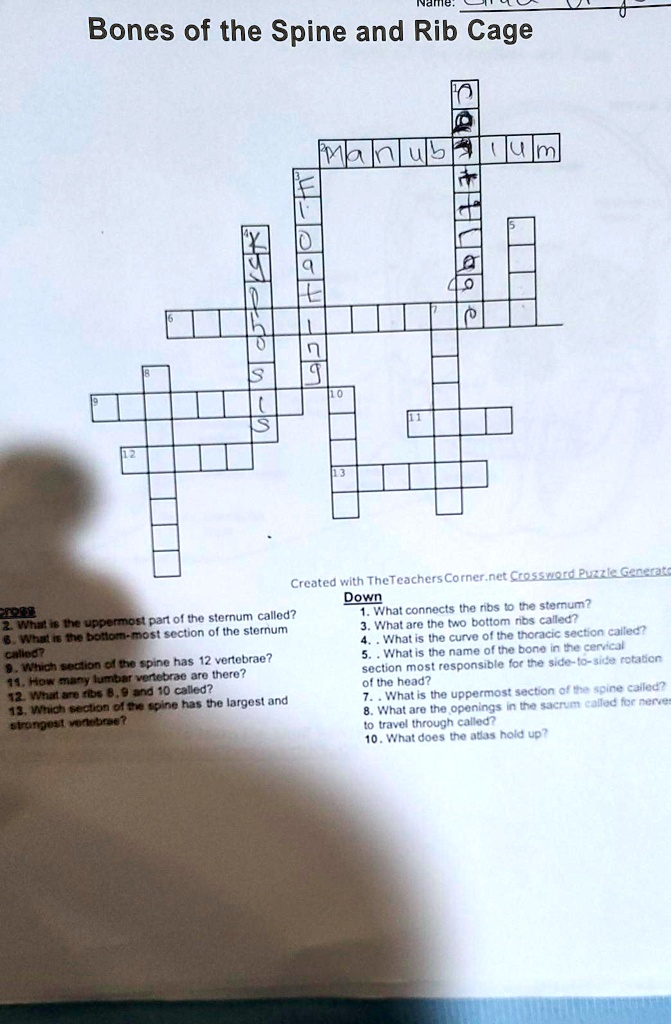
Bones of the Spine and Rib Cage Created with TheTeachersCorner.net Crossword Puzzle Generator Down 1. What connects the ribs to the sternum? 2. What is the uppermost part of the sternum called? 3. What are the two bottom ribs called? 4. What is the bottom-most section of the sternum called? 5. What is the curve of the thoracic section called? 6. What is the name of the bone in the cervical section of the spine? 7. Which section of the spine has 12 vertebrae? 8. What section is most responsible for the side-to-side rotation of the head? 9. How many lumbar vertebrae are there? 10. What are ribs 8, 9, and 10 called? 11. What is the uppermost section of the spine called? 12. Which section of the spine has the largest and strongest vertebrae? 13. What are the openings in the sacrum called for nerves to travel through? 14. What does the atlas hold up?
The Correct Answer and Explanation is:
Here are the correct answers for the “Bones of the Spine and Rib Cage” crossword puzzle, followed by a detailed explanation of the anatomical terms.
Correct Answers
Across
2. MANUBRIUM
6. XIPHOID
9. THORACIC
11. FIVE
12. FALSE
13. LUMBAR
Down
- CARTILAGE
- FLOATING
- KYPHOSIS
- AXIS
- CERVICAL
- FORAMINA
- SKULL
Explanation
This crossword puzzle provides an excellent overview of the key bones and structures of the human spine and rib cage, which work together to provide protection, support, and mobility.
The rib cage, a protective bony framework for the heart and lungs, is centered around the sternum, or breastbone. The puzzle correctly identifies the sternum’s primary sections. The broad, upper part is the manubrium (2-Across), which articulates with the clavicles and the first two pairs of ribs. The pointed, lower tip is the xiphoid process (6-Across), which is cartilaginous in youth and ossifies with age. The ribs connect to the sternum via costal cartilage (1-Down), a flexible tissue that permits the chest to expand and contract during respiration. Ribs are classified by their sternal attachment. Ribs 8, 9, and 10 are termed false ribs (12-Across) due to their indirect connection to the sternum through the cartilage of the rib above. The final two pairs are floating ribs (3-Down), as they lack any anterior connection to the sternum, protecting the posterior organs like the kidneys.
The vertebral column, or spine, is the body’s central support structure. It is segmented into distinct regions. The top region is the cervical spine (7-Down) in the neck, containing seven vertebrae. The first two, the atlas and axis, are highly specialized. The atlas (C1) supports the skull (10-Down), while the axis (C2) (5-Down) allows for the pivotal, side-to-side “no” motion of the head. The thoracic spine (9-Across) follows, composed of 12 vertebrae that connect to the 12 pairs of ribs. This section has a natural outward curve called kyphosis (4-Down). The lumbar spine (13-Across), located in the lower back, consists of five (11-Across) of the largest and strongest vertebrae, designed to bear significant body weight. At the base, the sacrum features openings known as foramina (8-Down), which serve as crucial passageways for spinal nerves.