Climate and weather. ram below. VENN DIAGRAM WEATHER CLIMATE Both WORD BOX Predictable Unpredictable Average Climatology Meteorology Precipitation Temperature Rainfall Jumidity Wind Direction/Speed Clouds pressure Evaporation Daily Short ter ng term Seasons yearly observed over
The Correct Answer and Explanation is:
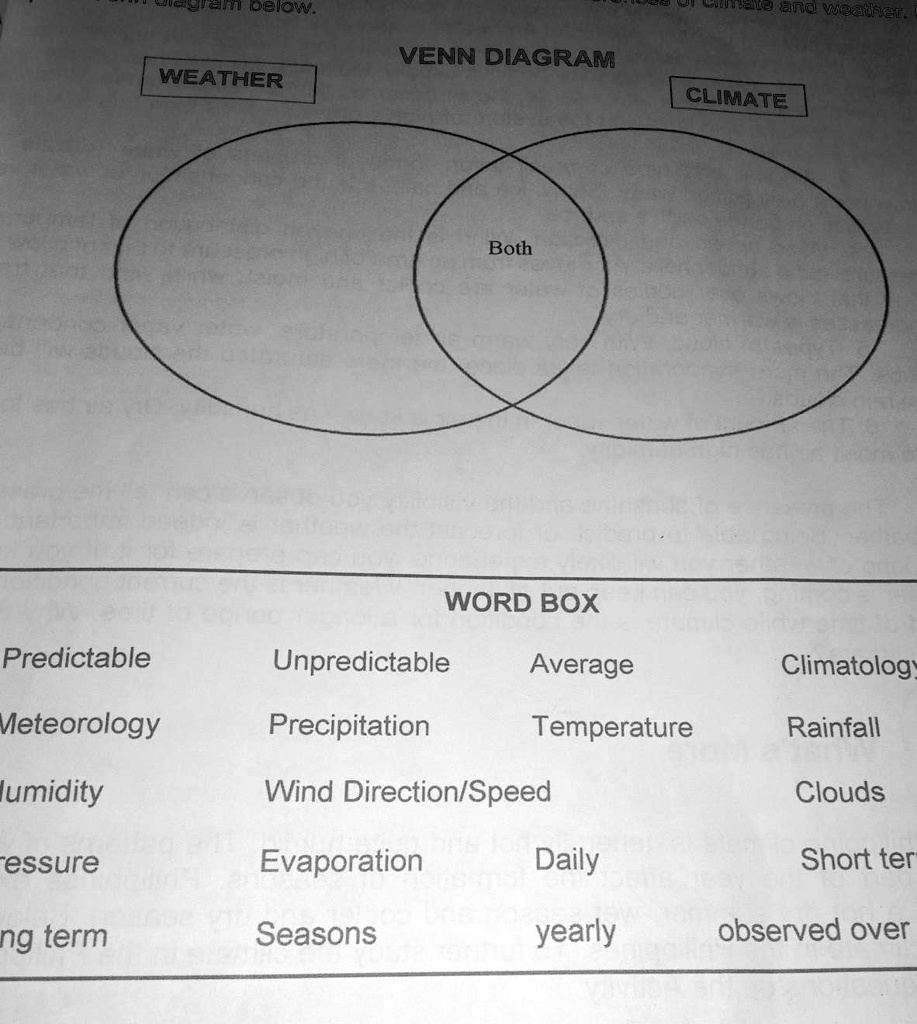
Here is the correct distribution of the words from the word box into the Venn diagram.
WEATHER
- Unpredictable
- Meteorology
- Daily
- Short term
BOTH
- Precipitation
- Temperature
- Rainfall
- Humidity
- Wind Direction/Speed
- Clouds
- Pressure
- Evaporation
CLIMATE
- Predictable
- Average
- Climatology
- Long term
- Seasons
- Yearly
- Observed over
Explanation
The distinction between weather and climate is primarily a matter of time and scale. Weather describes the state of the atmosphere at a specific time and place over a short period, while climate describes the long term patterns of weather in a particular area, typically averaged over 30 years or more.
The terms placed exclusively in the “WEATHER” category reflect its immediate and transient nature. Weather is what happens on a “Daily” basis and is considered a “Short term” phenomenon. Because it can change rapidly and unexpectedly, it is often described as “Unpredictable.” The science that studies these day to day atmospheric conditions is known as “Meteorology.”
Conversely, the “CLIMATE” category contains words that relate to long term trends and averages. Climate is defined by its “Long term” patterns, which are “Observed over” many years. It is expressed as an “Average” of weather conditions, making it more “Predictable” than daily weather. We can reliably predict that winter will be colder than summer, which is a feature of climate. This concept includes cyclical patterns like “Seasons” and is often analyzed on a “Yearly” basis. The scientific study of these long term patterns is “Climatology.”
The “BOTH” section includes the fundamental elements that are measured to describe atmospheric conditions. Variables like “Temperature,” “Precipitation,” “Humidity,” “Wind Direction/Speed,” “Pressure,” “Clouds,” “Rainfall,” and “Evaporation” are components of a daily weather report. However, these same variables are recorded and averaged over decades to define a region’s climate. For instance, a weather forecast might tell you the temperature for tomorrow, whereas climate data tells you the average temperature for that same day based on historical records. Therefore, these elements are the building blocks for both weather and climate.