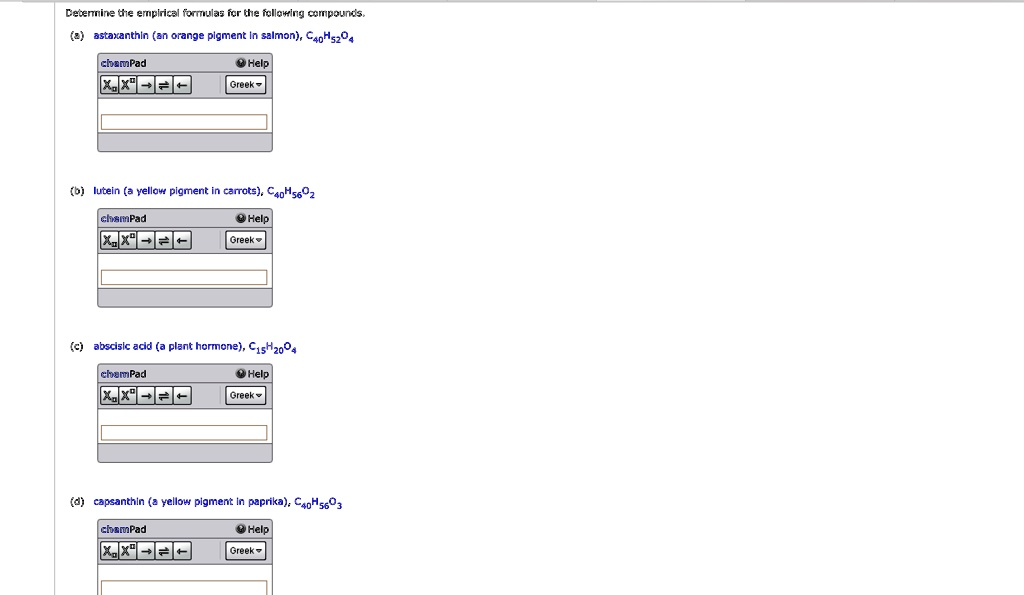
The Correct Answer and Explanation is:
Correct Answers:
(a) astaxanthin: C₁₀H₁₃O
(b) lutein: C₂₀H₂₈O
(c) abscisic acid: C₁₅H₂₀O₄
(d) capsanthin: C₄₀H₅₆O₃
Explanation
The empirical formula of a compound represents the simplest whole-number ratio of atoms of each element present in the compound. The molecular formula, on the other hand, gives the actual number of atoms of each element in one molecule. To determine the empirical formula from a given molecular formula, one must find the greatest common divisor (GCD) for the subscripts of the elements and then divide each subscript by this number.
(a) astaxanthin (C₄₀H₅₂O₄)
The molecular formula for astaxanthin is C₄₀H₅₂O₄. The subscripts for carbon, hydrogen, and oxygen are 40, 52, and 4, respectively. We need to find the greatest common divisor for these three numbers. The factors of 4 are 1, 2, and 4. We can check if 40 and 52 are also divisible by 4. Indeed, 40 divided by 4 is 10, and 52 divided by 4 is 13. Therefore, the GCD is 4. Dividing each subscript by 4 gives us:
- Carbon (C): 40 / 4 = 10
- Hydrogen (H): 52 / 4 = 13
- Oxygen (O): 4 / 4 = 1
The resulting empirical formula for astaxanthin is C₁₀H₁₃O.
(b) lutein (C₄₀H₅₆O₂)
For lutein, the molecular formula is C₄₀H₅₆O₂. The subscripts are 40, 56, and 2. The smallest subscript is 2, and its factors are 1 and 2. We check if the other subscripts are divisible by 2. Both 40 and 56 are even numbers, so they are divisible by 2. The GCD is 2. We divide each subscript by 2:
- Carbon (C): 40 / 2 = 20
- Hydrogen (H): 56 / 2 = 28
- Oxygen (O): 2 / 2 = 1
This gives the empirical formula for lutein as C₂₀H₂₈O.
(c) abscisic acid (C₁₅H₂₀O₄)
The molecular formula for abscisic acid is C₁₅H₂₀O₄. The subscripts are 15, 20, and 4. To find the GCD, we can list the factors of the smallest number, 4 (1, 2, 4). The number 15 is not divisible by 2 or 4. Since there is no common divisor other than 1 for all three subscripts, the molecular formula is already in its simplest whole number ratio. Therefore, the empirical formula is the same as the molecular formula: C₁₅H₂₀O₄.
(d) capsanthin (C₄₀H₅₆O₃)
For capsanthin, the molecular formula is C₄₀H₅₆O₃. The subscripts are 40, 56, and 3. The number 3 is a prime number, so its only divisors are 1 and 3. We check if 40 and 56 are divisible by 3. Neither 40 (4+0=4) nor 56 (5+6=11) is divisible by 3. This means the greatest common divisor for 40, 56, and 3 is 1. Consequently, the formula cannot be simplified further, and the empirical formula is identical to the molecular formula: C₄₀H₅₆O₃.