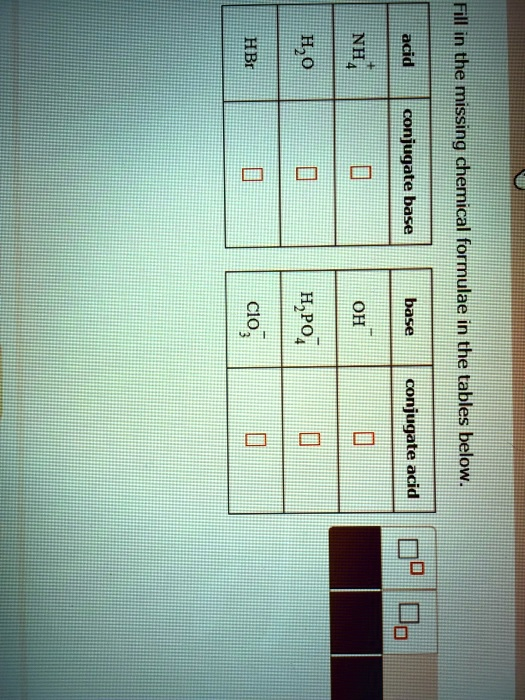
The Correct Answer and Explanation is:
Here are the completed tables with the correct chemical formulae:
Table 1: Acid and Conjugate Base
| acid | conjugate base |
| NH₄⁺ | NH₃ |
| H₂O | OH⁻ |
| HBr | Br⁻ |
Table 2: Base and Conjugate Acid
| base | conjugate acid |
| OH⁻ | H₂O |
| H₂PO₄⁻ | H₃PO₄ |
| ClO₃⁻ | HClO₃ |
Explanation
This exercise is based on the Brønsted-Lowry theory of acids and bases, which defines acids as proton (H⁺) donors and bases as proton acceptors. When an acid donates a proton, the remaining species is called its conjugate base. Conversely, when a base accepts a proton, the new species formed is its conjugate acid. A conjugate acid-base pair consists of two substances that differ only by the presence or absence of a single proton.
Finding a Conjugate Base from an Acid:
To find the conjugate base of an acid, you must remove one proton (H⁺) from the acid’s chemical formula. This involves two steps: first, removing a hydrogen atom (H), and second, decreasing the overall charge of the species by one.
- NH₄⁺: Removing one H⁺ from the ammonium ion (NH₄⁺) leaves ammonia (NH₃). The charge changes from +1 to 0.
- H₂O: Water can act as an acid. Removing one H⁺ from H₂O results in the hydroxide ion (OH⁻). The charge changes from 0 to -1.
- HBr: Hydrobromic acid (HBr) donates a proton to become the bromide ion (Br⁻). The charge changes from 0 to -1.
Finding a Conjugate Acid from a Base:
To find the conjugate acid of a base, you add one proton (H⁺) to the base’s chemical formula. This involves adding a hydrogen atom (H) and increasing the overall charge by one.
- OH⁻: The hydroxide ion (OH⁻) accepts a proton to form its conjugate acid, water (H₂O). The charge changes from -1 to 0.
- H₂PO₄⁻: The dihydrogen phosphate ion (H₂PO₄⁻) accepts a proton to become phosphoric acid (H₃PO₄). The charge changes from -1 to 0.
- ClO₃⁻: The chlorate ion (ClO₃⁻) accepts a proton, forming its conjugate acid, chloric acid (HClO₃). The charge changes from -1 to 0.