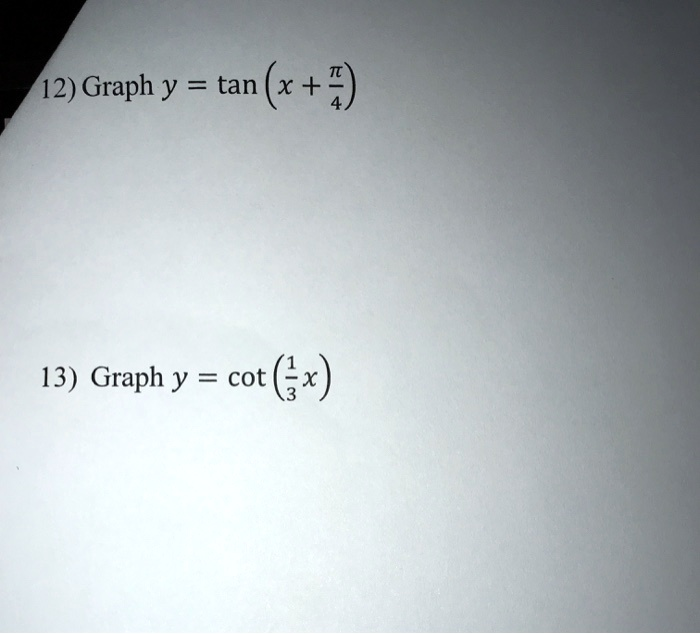
Graph y = tan (x + 4) 13) Graph y = cot (x)
The Correct Answer and Explanation is:
Of course. Here is the correct answer and a detailed explanation for graphing the two trigonometric functions from the image.
Correct Answer and Explanation
The problems require graphing two transformed trigonometric functions: y = tan(x + π/4) and y = cot(1/3 * x). This involves understanding the parent functions and applying transformations such as phase shifts and period changes.
12) Graphing y = tan(x + π/4)
To graph this function, we start with the parent function y = tan(x) and apply the given transformation. The equation is in the form y = tan(x – c), where the value of c determines the horizontal shift, also known as the phase shift. In this case, the equation is y = tan(x + π/4), which can be rewritten as y = tan(x – (-π/4)). This means c = -π/4, indicating a phase shift of π/4 units to the left.
The key features of the parent function y = tan(x) are its period of π and its vertical asymptotes at x = π/2 + nπ, where n is any integer. A typical cycle is centered at the origin, passing through (0, 0).
Applying the leftward shift of π/4:
- Period: The period is not affected by a horizontal shift, so it remains π.
- Asymptotes: Each asymptote of the parent function is shifted π/4 units to the left. The new asymptotes are located at x = (π/2 – π/4) + nπ, which simplifies to x = π/4 + nπ. For example, two consecutive asymptotes are at x = -3π/4 and x = π/4.
- Key Points: The center of a cycle, originally at (0, 0), shifts to (-π/4, 0). This point is now an x-intercept.
To sketch the graph, you would first draw the vertical asymptotes at x = π/4, x = 5π/4, etc. Then, plot the x-intercept halfway between two asymptotes, for example at x = -π/4. The graph retains its increasing S-shape, passing through (-π/2, -1) and (0, 1) within one cycle, and repeating this pattern every π units.
13) Graphing y = cot(1/3 * x)
This problem involves a transformation of the parent function y = cot(x). The equation y = cot(1/3 * x) is in the form y = cot(bx), where b affects the period of the function.
The key features of the parent function y = cot(x) are its period of π and its vertical asymptotes at x = nπ. It is a decreasing function between its asymptotes.
The transformation here is a horizontal stretch caused by b = 1/3.
- Period: The new period is calculated by the formula Period = π / |b|. So, the new period is π / (1/3) = 3π. This means the graph is stretched horizontally by a factor of 3, and one full cycle now spans a distance of 3π.
- Asymptotes: The original asymptotes at x = nπ are stretched by a factor of 3. We find their new locations by setting the argument of cotangent to nπ: (1/3)x = nπ, which gives x = 3nπ. Therefore, the new vertical asymptotes are at x = 0, x = 3π, x = -3π, and so on.
- Key Points: The x-intercept, originally at x = π/2, is now at x = (π/2) * 3 = 3π/2.
To sketch this graph, first draw the vertical asymptotes at x=0 and x=3π. Plot the x-intercept at (3π/2, 0). The graph is a decreasing curve that passes through points like (3π/4, 1) and (9π/4, -1), approaching the asymptotes on either side. This stretched cotangent shape repeats every 3π units along the x-axis.