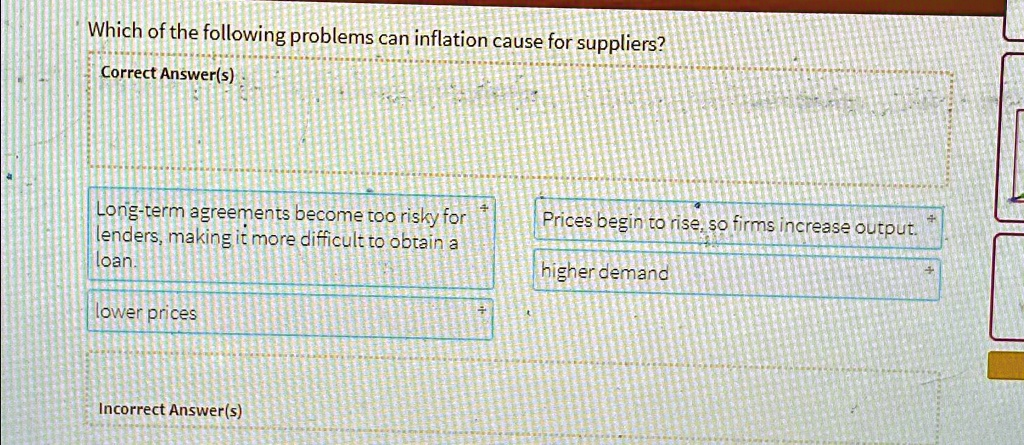
Which of the following problems can inflation cause for suppliers? Correct Answer(s) Long-term agreements become too risky for lenders, making it more difficult to obtain a loan. lower prices Incorrect Answer(s) Prices begin to rise, so firms increase output. higher demand
The Correct Answer and Explanation is:
Based on the options provided, here is the solution:
Correct Answer(s)
- Long-term agreements become too risky for lenders, making it more difficult to obtain a loan.
Incorrect Answer(s)
- lower prices
- Prices begin to rise, so firms increase output.
- higher demand
Explanation
Inflation, which is a sustained increase in the general price level of goods and services, creates significant uncertainty and challenges for suppliers. The most direct problem listed is the impact on financing.
The correct answer is that long term agreements become too risky for lenders, making it more difficult for suppliers to obtain a loan. High and unpredictable inflation erodes the future value of money. For a lender, this means the fixed payments they receive on a long term loan will be worth less in real terms over time. To protect themselves from this loss of purchasing power, lenders may become reluctant to issue long term loans or will only do so at much higher interest rates to include an “inflation premium.” This makes it more difficult and expensive for suppliers to secure the capital they need for investments, expansion, or even covering operational costs, thereby hindering their business.
The other options are incorrect because they either misrepresent the effects of inflation or are not considered problems for a supplier. “Lower prices” is the opposite of inflation. “Higher demand” is generally a positive outcome for a supplier, not a problem, as it means more potential sales. Finally, the statement that “Prices begin to rise, so firms increase output” describes a potential short term incentive, not a problem. If a supplier’s selling prices rise faster than their input costs, their profit margins increase, which can encourage them to produce more. While sustained inflation eventually leads to rising input costs that squeeze profits, the initial response of increasing output to meet rising prices is a rational business decision, not a problem in itself.