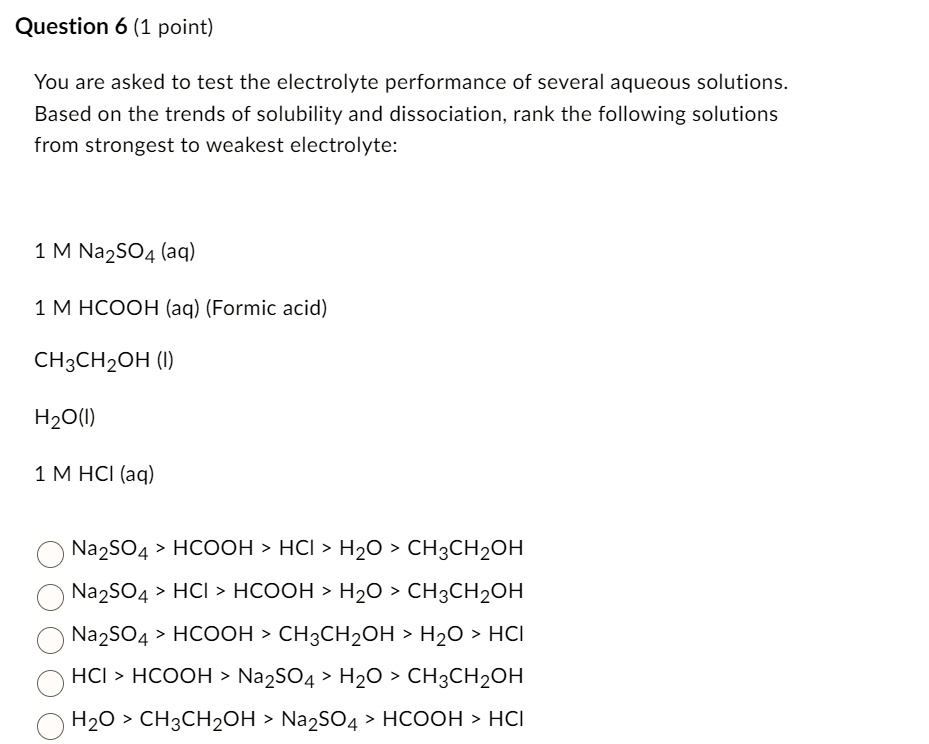
Question 6 (1 point) You are asked to test the electrolyte performance of several aqueous solutions
The Correct Answer and Explanation is:
The correct answer is Na₂SO₄ > HCl > HCOOH > H₂O > CH₃CH₂OH.
Here is the explanation:
The strength of an electrolyte is determined by its ability to dissociate into ions when dissolved in a solvent like water. A higher concentration of ions results in a stronger electrolyte solution, which is a better conductor of electricity. We can rank the given substances by classifying them as strong, weak, or non-electrolytes.
- Strong Electrolytes: These substances dissociate completely, or almost completely, into ions.
- 1 M Na₂SO₄ (Sodium Sulfate): As a soluble ionic salt, sodium sulfate dissociates completely in water. Each formula unit produces three ions: two sodium ions (Na⁺) and one sulfate ion (SO₄²⁻). A 1 M solution yields a total ion concentration of 3 M, making it the strongest electrolyte on the list.
- 1 M HCl (Hydrochloric Acid): As a strong acid, HCl also dissociates completely in water. Each molecule produces two ions: one hydrogen ion (H⁺) and one chloride ion (Cl⁻). A 1 M solution yields a total ion concentration of 2 M. While it is a strong electrolyte, it produces fewer ions per mole than Na₂SO₄, so it is ranked second.
- Weak Electrolytes: These substances only partially dissociate into ions, creating an equilibrium between the molecular form and the ionic form.
- 1 M HCOOH (Formic Acid): This is a weak acid. Only a small fraction of its molecules ionize in water to form H⁺ and HCOO⁻ ions. Its ion concentration is significantly lower than that of the strong electrolytes, making it a weak electrolyte.
- H₂O (Water): Pure water itself undergoes autoionization (2H₂O ⇌ H₃O⁺ + OH⁻), but to a very minimal extent. It produces a very low concentration of ions, making it a very weak electrolyte, weaker than the 1 M solution of formic acid.
- Non-electrolyte: This type of substance dissolves in water but does not produce any ions.
- CH₃CH₂OH (Ethanol): Ethanol is a molecular compound. It dissolves in water due to hydrogen bonding, but it does not ionize. Since it produces no ions, it does not conduct electricity and is considered a non-electrolyte, making it the weakest on the list.
Based on this analysis, the order from strongest to weakest electrolyte is: Na₂SO₄ > HCl > HCOOH > H₂O > CH₃CH₂OH.