NH3 is a weak base (Kb=1.8×10⁻⁵) and so the salt NH4Cl acts as a weak acid
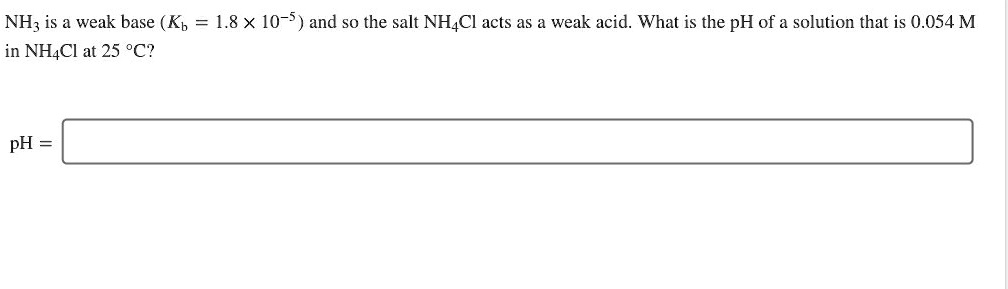
The Correct Answer and Explanation is:
5.26
To determine the pH of the 0.054 M ammonium chloride (NH₄Cl) solution, we first need to understand the chemical reaction occurring in the water.
Ammonium chloride is a salt formed from a weak base, ammonia (NH₃), and a strong acid, hydrochloric acid (HCl). When dissolved in water, it dissociates completely into its ions:
NH₄Cl(aq) → NH₄⁺(aq) + Cl⁻(aq)
The chloride ion (Cl⁻) is the conjugate base of a strong acid, so it is a spectator ion and does not affect the pH. The ammonium ion (NH₄⁺), however, is the conjugate acid of the weak base ammonia. It will react with water in a process called hydrolysis, which makes the solution acidic. The equilibrium reaction is:
NH₄⁺(aq) + H₂O(l) ⇌ NH₃(aq) + H₃O⁺(aq)
To find the pH, we need the concentration of hydronium ions [H₃O⁺] at equilibrium. This requires the acid dissociation constant, Ka, for the ammonium ion. We can calculate Ka from the given base dissociation constant, Kb, for ammonia (1.8 × 10⁻⁵) and the ion product constant for water, Kw (1.0 × 10⁻¹⁴ at 25 °C), using the relationship:
Ka × Kb = Kw
Ka = Kw / Kb = (1.0 × 10⁻¹⁴) / (1.8 × 10⁻⁵) = 5.56 × 10⁻¹⁰
Next, we use an ICE (Initial, Change, Equilibrium) table to find the equilibrium concentrations. Let ‘x’ be the change in concentration.
Initial: [NH₄⁺] = 0.054 M; [NH₃] = 0; [H₃O⁺] = 0
Change: [NH₄⁺] = -x; [NH₃] = +x; [H₃O⁺] = +x
Equilibrium: [NH₄⁺] = 0.054 – x; [NH₃] = x; [H₃O⁺] = x
The Ka expression is:
Ka = ([NH₃][H₃O⁺]) / [NH₄⁺]
5.56 × 10⁻¹⁰ = (x)(x) / (0.054 – x)
Since Ka is very small, we can assume x is negligible compared to 0.054, simplifying the equation to:
5.56 × 10⁻¹⁰ ≈ x² / 0.054
x² = (5.56 × 10⁻¹⁰) * 0.054 = 3.00 × 10⁻¹¹
x = √(3.00 × 10⁻¹¹) = 5.48 × 10⁻⁶ M
So, the equilibrium concentration of H₃O⁺ is 5.48 × 10⁻⁶ M. Finally, we calculate the pH:
pH = -log[H₃O⁺] = -log(5.48 × 10⁻⁶) = 5.26