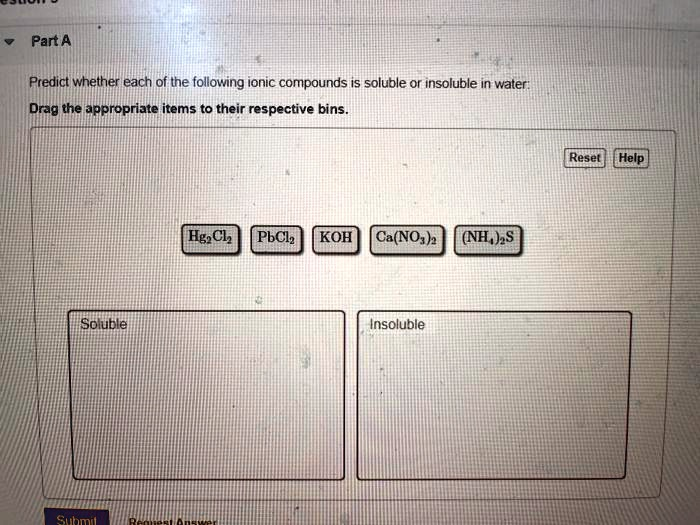
Predict whether each of the following ionic compounds is soluble or insoluble in water: Drag the appropriate items to their respective bins. HgCl2 PbCl2 KOH Ca(NO3)2 (NH4)2S Soluble Insoluble
The Correct Answer and Explanation is:
Based on the general solubility rules for ionic compounds in water, here is the correct classification:
Soluble
- KOH
- Ca(NO₃)₂
- (NH₄)₂S
Insoluble
- Hg₂Cl₂
- PbCl₂
Explanation
To determine if an ionic compound is soluble or insoluble in water, we use a set of established solubility guidelines. Let’s apply these rules to each compound provided.
Soluble Compounds:
- KOH (Potassium hydroxide): This compound is soluble. The rule states that all compounds containing a Group 1 alkali metal cation, such as potassium (K⁺), are soluble in water. This rule takes precedence over the general rule that hydroxides are insoluble.
- Ca(NO₃)₂ (Calcium nitrate): This compound is soluble. A key solubility rule is that all compounds containing the nitrate anion (NO₃⁻) are soluble. There are no common exceptions to this rule, making calcium nitrate readily dissolve in water.
- (NH₄)₂S (Ammonium sulfide): This compound is soluble. Similar to alkali metal cations, all compounds containing the ammonium cation (NH₄⁺) are soluble in water. This guideline overrides the general rule that most sulfides (S²⁻) are insoluble.
Insoluble Compounds:
- Hg₂Cl₂ (Mercury(I) chloride): This compound is insoluble. While most compounds containing the chloride anion (Cl⁻) are soluble, there are important exceptions. One of these exceptions is for compounds formed with the mercury(I) ion (Hg₂²⁺). Therefore, mercury(I) chloride does not dissolve in water.
- PbCl₂ (Lead(II) chloride): This compound is also insoluble. It falls under the same rule as mercury(I) chloride. Chlorides are generally soluble, but lead(II) (Pb²⁺) is another one of the specific exceptions. Consequently, lead(II) chloride is considered insoluble in water at standard temperatures.