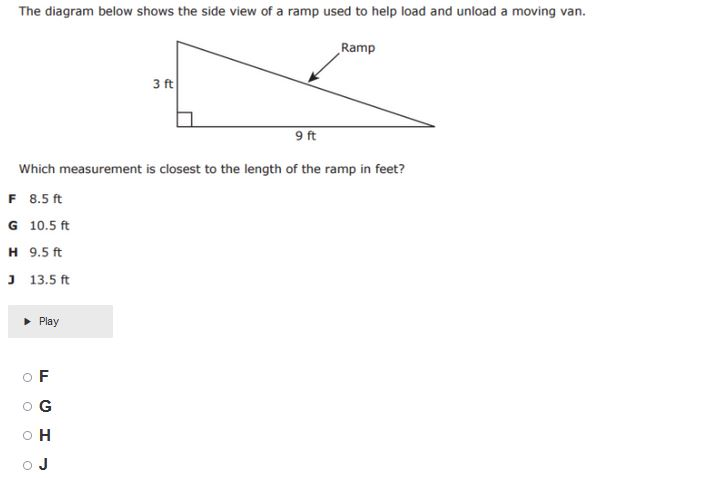
The diagram below shows the side view of a ramp used to help load and unload a moving van
The Correct Answer and Explanation is:
The correct answer is H.
This problem can be solved using the Pythagorean theorem, a fundamental principle of geometry for right-angled triangles. The theorem states that the square of the length of the hypotenuse (the side opposite the right angle) is equal to the sum of the squares of the lengths of the other two sides (the legs). The formula is expressed as a² + b² = c², where ‘a’ and ‘b’ are the lengths of the legs and ‘c’ is the length of the hypotenuse.
In the diagram, the ramp forms the hypotenuse of a right-angled triangle. The two legs of the triangle are the vertical height and the horizontal length.
The vertical height (leg ‘a’) is given as 3 feet.
The horizontal length (leg ‘b’) is given as 9 feet.
The length of the ramp is the hypotenuse (‘c’), which is what we need to find.
We can plug the known values into the Pythagorean theorem:
a² + b² = c²
3² + 9² = c²
First, we calculate the square of each leg:
3² = 3 × 3 = 9
9² = 9 × 9 = 81
Next, we add these two results together:
9 + 81 = 90
This gives us the equation:
90 = c²
To find the value of ‘c’, we must take the square root of 90:
c = √90
To find the closest measurement, we can estimate the square root of 90. We know that 9² = 81 and 10² = 100. Since 90 is between 81 and 100, its square root will be between 9 and 10. Calculating 9.5² gives us 90.25, which is very close to 90. The actual value of the square root of 90 is approximately 9.487.
Comparing our calculated value of approximately 9.487 ft to the answer choices:
F: 8.5 ft
G: 10.5 ft
H: 9.5 ft
J: 13.5 ft
The value 9.487 ft is closest to 9.5 ft. Thus, option H is the correct answer