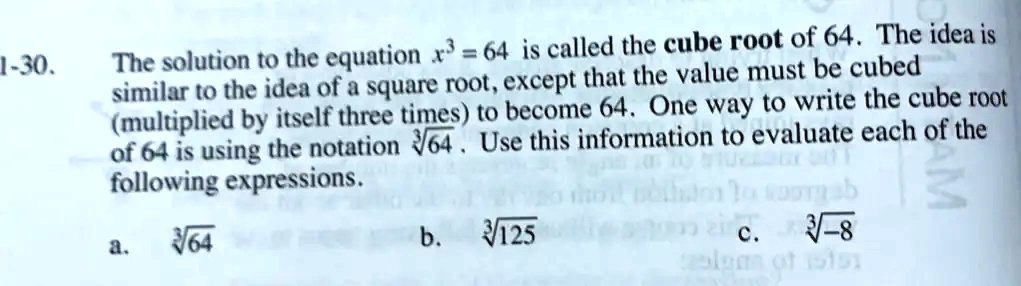
The solution to the equation x3=64 is called the cube root of 64
The Correct Answer and Explanation is:
Here are the correct answers to the expressions:
a. 4
b. 5
c. -2
Explanation
The problem asks us to evaluate several cube roots based on the provided definition. A cube root of a number is a special value that, when multiplied by itself three times, results in the original number. This operation is the inverse of cubing a number. For example, the solution to the equation x³ = 64 is the cube root of 64. We will apply this principle to solve each part of the question.
a. ³√64
To find the cube root of 64, we need to determine which number, when cubed, equals 64. We can test small integers to find the answer. We know that 1³ = 1 × 1 × 1 = 1. Moving to the next integer, 2³ = 2 × 2 × 2 = 8. Then, 3³ = 3 × 3 × 3 = 27. Let’s try 4. Calculating 4³ means we multiply 4 × 4 × 4. The first two fours multiply to 16 (4 × 4 = 16), and then we multiply that result by the final 4 (16 × 4 = 64). Since 4³ is equal to 64, the cube root of 64 is 4.
b. ³√125
For this part, we are looking for the number that, when multiplied by itself three times, gives 125. We can continue our testing from the previous problem. We already know that 4³ is 64, so the answer must be a larger number. Let’s test the next integer, 5. To find 5³, we calculate 5 × 5 × 5. The product of the first two fives is 25 (5 × 5 = 25). Then, we multiply this by the third 5 (25 × 5 = 125). Because 5³ equals 125, the cube root of 125 is 5.
c. ³√-8
This part involves finding the cube root of a negative number. The concept remains the same: we need a number ‘x’ such that x³ = -8. A positive number cubed always results in a positive number, so the answer must be negative. A negative number multiplied by itself an odd number of times will produce a negative result. For example, (-a) × (-a) × (-a) = a² × (-a) = -a³. Let’s test small negative integers. We can start with -1, where (-1)³ = -1. Let’s try -2. The calculation is (-2) × (-2) × (-2). The first part of the multiplication, (-2) × (-2), results in a positive 4. We then multiply this 4 by the remaining -2, which gives us -8. Since (-2)³ equals -8, the cube root of -8 is -2.