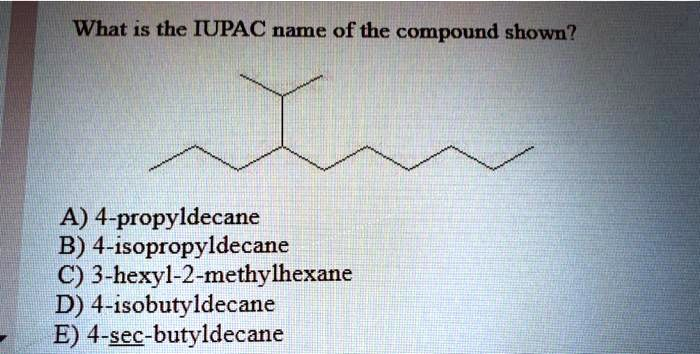
What is the IUPAC name of the compound shown? A) 4-propyldecane B) 4-isopropyldecane C) 3-hexyl-2-methylhexane D) 4-isobutyldecane E) 4-sec-butyldecane
The Correct Answer and Explanation is:
The correct answer is B) 4-isopropyldecane.
To determine the International Union of Pure and Applied Chemistry (IUPAC) name for the compound, we follow a systematic set of rules.
First, we must identify the longest continuous chain of carbon atoms in the molecule. This chain is the parent alkane and forms the base of the name. If we trace the carbon chain horizontally from left to right, we count a total of ten carbon atoms. Exploring other paths, such as starting from the substituent group and moving along the chain, results in shorter chains (for instance, a nine-carbon chain). Therefore, the longest continuous chain has ten carbons, and the parent name of the compound is decane.
Second, we need to number the carbon atoms in the parent chain. The numbering should start from the end that gives the substituent group the lowest possible number, or locant. If we number the decane chain from left to right, the substituent is attached to the fourth carbon atom (C4). If we number from right to left, the substituent is attached to the seventh carbon atom (C7). According to IUPAC rules, we must choose the numbering that results in the lower locant, so the substituent is at position 4.
Third, we identify the substituent group attached to the parent chain. The group at position 4 is a three-carbon alkyl group. It is attached to the main decane chain through its central carbon atom. A three-carbon substituent attached in this manner is called an isopropyl group. If it were attached by an end carbon, it would be a propyl group.
Finally, we assemble the complete IUPAC name by combining the locant, the substituent name, and the parent name. The format is (locant)-(substituent name)(parent name). This gives us the name 4-isopropyldecane. This matches option B. The other options are incorrect because they either misidentify the parent chain, the substituent, or its position.