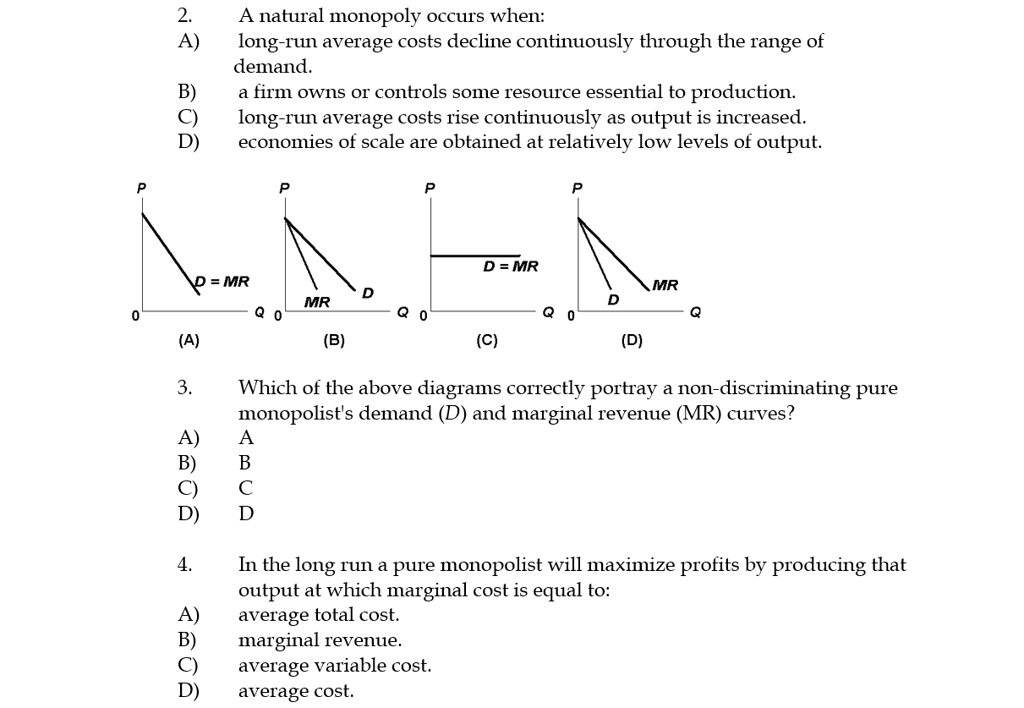
A natural monopoly occurs when: long-run average costs decline continuously through the range of demand. A firm owns or controls some resource essential to production. Long-run average costs rise continuously as output is increased. Economies of scale are obtained at relatively low levels of output. B) C) D) D = MR MR MR MR D 08 Q 0 (A) (B) (C) (D) 3. Which of the above diagrams correctly portray a non-discriminating pure monopolist’s demand (D) and marginal revenue (MR) curves? A B C D A) B) C) D) 4. In the long run, a pure monopolist will maximize profits by producing that output at which marginal cost is equal to: average total cost. Marginal revenue. Average variable cost. Average cost. A) B) C) D)
The Correct Answer and Explanation is:
Here are the correct answers and a detailed explanation for each question.
Correct Answers:
2. A) long-run average costs decline continuously through the range of demand.
3. B) B
4. B) marginal revenue.
Explanation
2. Understanding a Natural Monopoly
The correct answer is A. A natural monopoly is a specific type of monopoly that arises from the unique cost structure of an industry. The defining characteristic is the presence of vast economies of scale, meaning that as a single firm increases its production, its long-run average cost (LRAC) per unit decreases. This cost advantage is so significant that one firm can supply the entire market’s demand at a lower average cost than two or more smaller firms could. Therefore, option A, which states that “long-run average costs decline continuously through the range of demand,” is the precise definition.
Option B describes a resource monopoly, not necessarily a natural one. Options C and D describe conditions that would discourage a monopoly from forming; rising average costs (C) or economies of scale that are exhausted at low output levels (D) would make it easier for new firms to enter and compete effectively.
3. A Monopolist’s Demand and Marginal Revenue Curves
The correct answer is B. For a non-discriminating pure monopolist, the demand curve (D) is the same as the market demand curve, which is downward sloping. This reflects the fact that to sell more of its product, the monopolist must lower the price.
Crucially, the marginal revenue (MR) curve is not the same as the demand curve. Marginal revenue is the additional revenue gained from selling one more unit. Because the monopolist must lower the price on all units to sell an additional one, the revenue gained from that last unit is less than the price it sells for. As a result, the marginal revenue curve always lies below the demand curve.
Diagram (B) correctly illustrates this relationship: it shows a downward-sloping demand curve (D) with a corresponding marginal revenue curve (MR) that is also downward sloping but positioned below the demand curve. Diagram (A) and (C) represent a perfectly competitive firm, where price is constant, so D = MR. Diagram (D) is incorrect as it shows MR above D, which is impossible.
4. The Profit Maximization Rule
The correct answer is B. The fundamental rule for profit maximization for any firm, including a pure monopolist, is to produce at the quantity where marginal revenue (MR) equals marginal cost (MC). This rule applies in both the short run and the long run.
The logic is straightforward:
- If MR > MC, the firm can increase its profit by producing and selling one more unit because the additional revenue exceeds the additional cost.
- If MR < MC, the firm is losing profit on the last unit produced and should reduce its output.
Therefore, profit is maximized at the output level where the firm can no longer increase profit by adjusting production, which is precisely where MR = MC. The other options are incorrect; setting marginal cost equal to average cost (A, D) or average variable cost (C) relates to concepts of efficiency or shutdown points, not profit maximization.