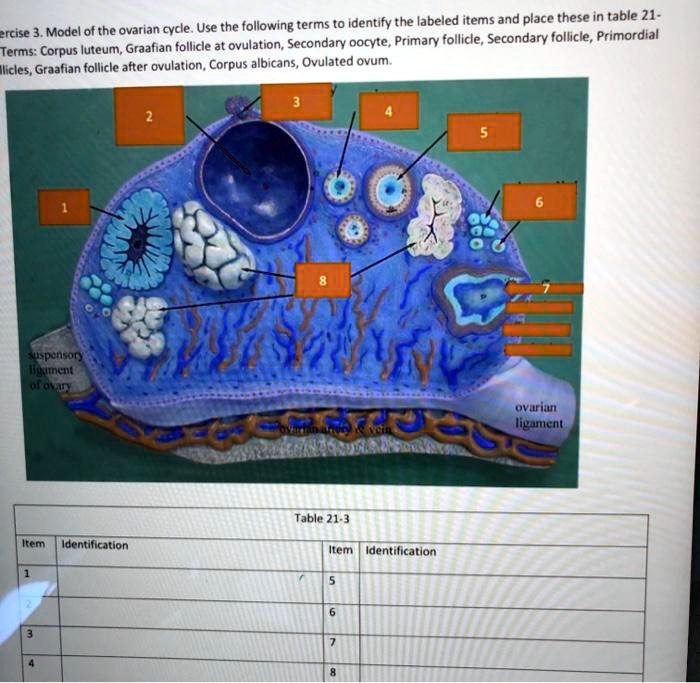
Model of the ovarian cycle. Use the following terms to identify the labeled items and place these in table 21- Terms: Corpus luteum, Graafian follicle at ovulation, Secondary oocyte, Primary follicle, Secondary follicle, Primordial licles, Graafian follicle after ovulation, Corpus albicans, Ovulated ovum. 1 Suspensory ligament of ovary 2 3 4 5 8 6 ovarian artery Vein ovarian ligament Table 21-3 Item Identification 1 2 3 4 Item Identification 5 6 7 8
The Correct Answer and Explanation is:
Based on the image provided, here is the identification of the labeled items according to the ovarian cycle terms:
- Item 1: Primordial follicle
The primordial follicles are in the initial stages of development, typically characterized by a single layer of granulosa cells surrounding an oocyte. - Item 2: Primary follicle
Primary follicles are slightly more advanced than primordial follicles. They consist of a layer of granulosa cells around the oocyte. - Item 3: Secondary follicle
Secondary follicles have an antral space (the beginning of fluid-filled spaces) and are larger than primary follicles. - Item 4: Graafian follicle at ovulation
The Graafian follicle is the mature follicle right before ovulation, characterized by a large antral cavity. This is the stage where the follicle is ready for ovulation. - Item 5: Ovulated ovum
This is the egg (oocyte) that has been released during ovulation from the Graafian follicle. - Item 6: Corpus luteum
After ovulation, the Graafian follicle transforms into the corpus luteum, which secretes progesterone to maintain the uterine lining for potential pregnancy. - Item 7: Corpus albicans
If pregnancy does not occur, the corpus luteum degenerates and becomes the corpus albicans, a scar tissue-like structure. - Item 8: Graafian follicle after ovulation
This is the stage after ovulation, where the follicle is no longer ovulatory but is in the process of transforming into the corpus luteum.
Explanation:
The ovarian cycle involves the maturation of follicles in the ovary, with the ultimate goal of releasing a mature oocyte (egg). The cycle is broken down into phases: the follicular phase, ovulation, and the luteal phase. In the image, the follicles represent various stages of development, starting from the primordial follicle, which develops into the primary follicle, then the secondary follicle, and finally the mature Graafian follicle. After ovulation, the ruptured Graafian follicle becomes the corpus luteum, which supports pregnancy if fertilization occurs. If not, the corpus luteum degrades into the corpus albicans.