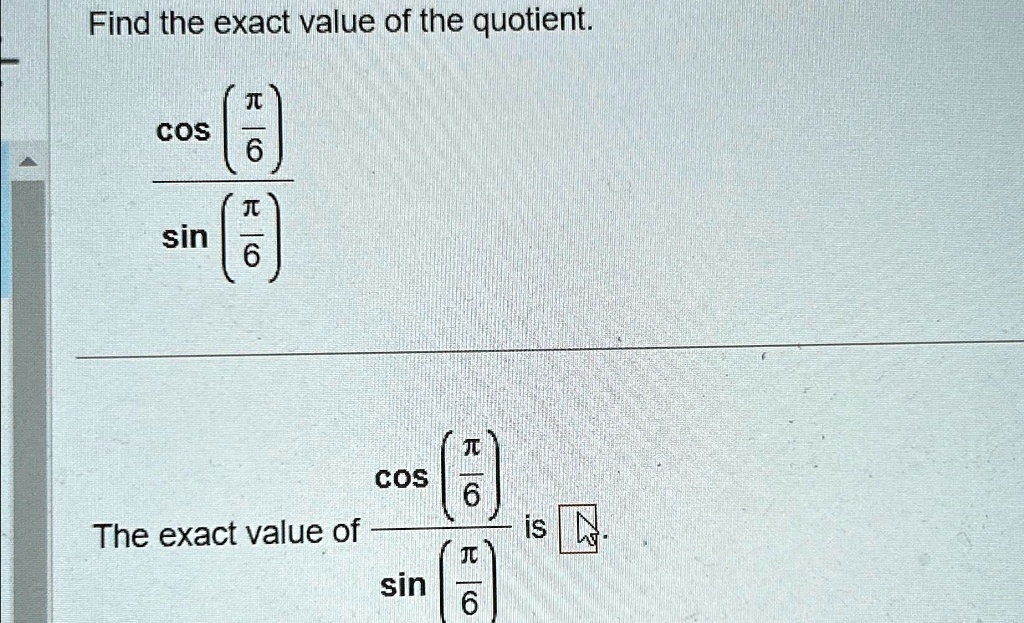
Find the exact value of the quotient.\ \frac{\cos\left(\frac{\pi}{6}\right)}{\sin\left(\frac{\pi}{6}\right)}\ The exact value of \frac{\cos\left(\frac{\pi}{6}\right)}{\sin\left(\frac{\pi}{6}\right)} is
The Correct Answer and Explanation is:
The exact value of the expression is √3.
To find the exact value of the quotient cos(π/6) / sin(π/6), we can approach the problem in two ways: by using a trigonometric identity or by direct calculation of the individual values.
Method 1: Using the Cotangent Identity
A fundamental identity in trigonometry states that the cotangent of an angle (θ) is equal to the cosine of the angle divided by the sine of the angle. This is expressed as:
cot(θ) = cos(θ) / sin(θ)
By applying this identity to the given expression, we can see that we are being asked to find the value of cot(π/6).
To find this value, we can use the properties of a 30-60-90 special right triangle, as the angle π/6 radians is equivalent to 30 degrees. In a 30-60-90 triangle, the side lengths are in the ratio 1 : √3 : 2.
- The side opposite the 30° (π/6) angle is 1.
- The side adjacent to the 30° (π/6) angle is √3.
- The hypotenuse is 2.
The definition of cotangent is the ratio of the adjacent side to the opposite side. Therefore:
cot(π/6) = (Adjacent Side) / (Opposite Side) = √3 / 1 = √3
Method 2: Direct Calculation
Alternatively, we can find the individual exact values for cos(π/6) and sin(π/6) and then perform the division. Using the same 30-60-90 triangle:
- Find the value of sin(π/6):
The sine of an angle is the ratio of the opposite side to the hypotenuse.
sin(π/6) = (Opposite Side) / (Hypotenuse) = 1/2 - Find the value of cos(π/6):
The cosine of an angle is the ratio of the adjacent side to the hypotenuse.
cos(π/6) = (Adjacent Side) / (Hypotenuse) = √3 / 2 - Calculate the quotient:
Now, substitute these values back into the original expression:
cos(π/6) / sin(π/6) = (√3 / 2) / (1/2)To divide by a fraction, we multiply by its reciprocal:
(√3 / 2) * (2 / 1) = (2 * √3) / 2The 2 in the numerator cancels out the 2 in the denominator, leaving the final answer:
√3
Both methods confirm that the exact value of the quotient is √3.