The Correct Answer and Explanation is:
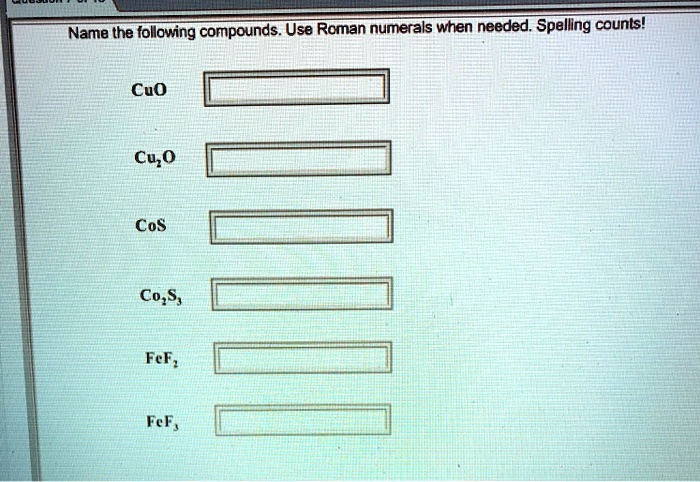
Here are the correct names for the chemical compounds listed:
- CuO: Copper(II) oxide
- Cu₂O: Copper(I) oxide
- CoS: Cobalt(II) sulfide
- Co₂S₃: Cobalt(III) sulfide
- FeF₂: Iron(II) fluoride
- FeF₃: Iron(III) fluoride
The compounds listed are all binary ionic compounds, which consist of a metal and a nonmetal.[1] A key feature of the metals in these specific examples—copper (Cu), cobalt (Co), and iron (Fe)—is that they are transition metals. Transition metals are capable of forming more than one type of positively charged ion, or cation, with different charges.[2][3] To avoid ambiguity when naming compounds containing these metals, the charge of the metal ion is specified using a Roman numeral in parentheses immediately after the metal’s name.[1]
To determine the correct Roman numeral, one must consider the charge of the nonmetal ion, or anion. Nonmetals in these compounds have a fixed negative charge. For instance, the oxide ion (O) has a charge of 2-, the sulfide ion (S) has a charge of 2-, and the fluoride ion (F) has a charge of 1-. Since the overall charge of a compound must be neutral, the total positive charge from the metal cations must balance the total negative charge from the anions.
Here’s a breakdown for each compound:
- In CuO, there is one oxide ion with a 2- charge. To balance this, the single copper ion must have a 2+ charge, making the name Copper(II) oxide.[4][5][6]
- In Cu₂O, the single oxide ion has a 2- charge. This charge is balanced by two copper ions, meaning each copper ion must have a 1+ charge. Thus, the name is Copper(I) oxide.[7][8][9]
- In CoS, one sulfide ion has a 2- charge, so the cobalt ion must have a 2+ charge.[10][11] This leads to the name Cobalt(II) sulfide.[10]
- In Co₂S₃, there are three sulfide ions, giving a total negative charge of 6- (3 x 2-). This is balanced by two cobalt ions, so each must have a 3+ charge. The name is therefore Cobalt(III) sulfide.[12][13][14]
- In FeF₂, two fluoride ions give a total negative charge of 2- (2 x 1-). The single iron ion must have a 2+ charge to balance this, resulting in the name Iron(II) fluoride.[15][16]
- In FeF₃, three fluoride ions create a total negative charge of 3- (3 x 1-). Consequently, the iron ion must have a 3+ charge.[17][18] The correct name is Iron(III) fluoride.
Sources help
- libretexts.org
- youtube.com
- quizlet.com
- brainly.com
- brainly.com
- cgiar.org
- brainly.com
- gauthmath.com
- youtube.com
- youtube.com
- youtube.com
- youtube.com
- chegg.com
- brainly.com
- brainly.com
- noahchemicals.com
- brainly.com
- brainly.com