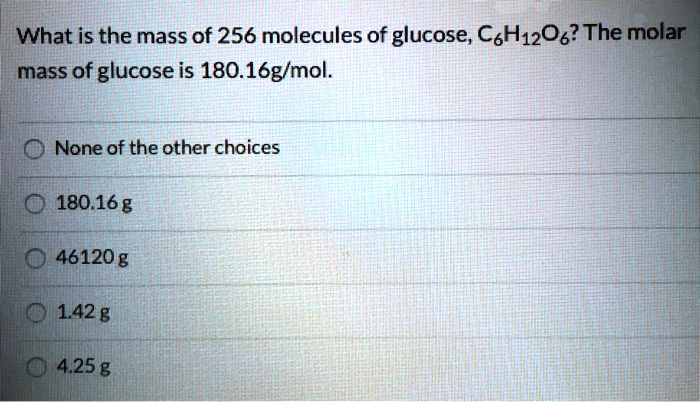
What is the mass of 256 molecules of glucose, C6 H12 O6
The Correct Answer and Explanation is:
The correct answer is None of the other choices.
To determine the mass of a specific number of molecules, we must use two key concepts in chemistry: Avogadro’s number and molar mass. Avogadro’s number, which is approximately 6.022 x 10²³ particles per mole, provides the conversion factor between the number of individual particles (like molecules) and the amount in moles. The molar mass, given as 180.16 grams per mole ( g/mol ) for glucose, tells us the mass of one mole of that substance.
The calculation involves a two-step process. First, we convert the given number of glucose molecules into moles. This is done by dividing the number of molecules by Avogadro’s number:
Moles = 256 molecules / (6.022 x 10²³ molecules/mol) ≈ 4.25 x 10⁻²² moles
This result shows that 256 molecules is an exceptionally small fraction of a mole, which is expected since a mole contains an enormous number of molecules.
Second, we convert this amount in moles into mass using the molar mass of glucose. We multiply the number of moles by the molar mass:
Mass = (4.25 x 10⁻²² moles) × (180.16 g/mol ) ≈ 7.66 x 10⁻²⁰ grams
This calculated mass is an extremely small number, far smaller than any of the numerical options provided. The option “180.16 g” represents the mass of one full mole of glucose, not 256 molecules. The option “46120 g” is the incorrect result of multiplying the number of molecules directly by the molar mass (256 × 180.16), confusing molecules with moles. Since our calculated mass of approximately 7.66 x 10⁻²⁰ grams does not match any of the other choices, the correct selection is “None of the other choices”.