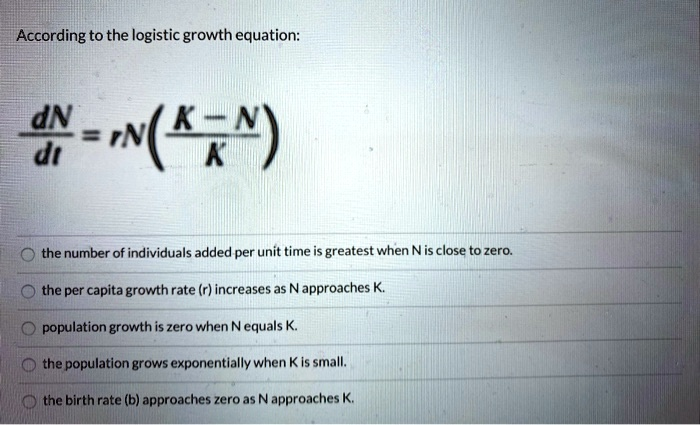
The Correct Answer and Explanation is:
The correct answer is: population growth is zero when N equals K.
This statement is a direct consequence of the logistic growth equation, which models how a population’s growth rate changes as it approaches its environmental limit. Let’s break down the equation and analyze why this answer is correct.
The logistic growth equation is:
dN/dt = rN((K – N) / K)
Here’s what each variable represents:
- dN/dt: This is the rate of population growth, meaning the change in population size (N) over a period of time (t).
- r: The maximum intrinsic rate of natural increase for the population. This is the rate at which the population would grow if there were no limiting factors.
- N: The current population size.
- K: The carrying capacity of the environment, which is the maximum population size that the environment can sustainably support.
- (K – N) / K: This term represents the environmental resistance. It reflects how much of the carrying capacity is still available. As the population (N) gets closer to the carrying capacity (K), this fraction gets smaller, slowing down the population’s growth.
Now let’s evaluate the correct statement: “population growth is zero when N equals K.”
If we substitute N with K in the equation, we get:
dN/dt = rK((K – K) / K)
dN/dt = rK(0 / K)
dN/dt = rK(0)
dN/dt = 0
When dN/dt equals 0, it means there is no change in the population size over time; the population growth is zero. This happens because the population has reached the maximum size the environment can support. At this point, the number of births equals the number of deaths, resulting in a stable population. The other options are incorrect because the growth rate is actually highest at half the carrying capacity (N=K/2), not near zero, and the per capita growth rate decreases, not increases, as N approaches K.