For 0 to 24 hours, the temperature inside a refrigerator in a kitchen is given by the function that satisfies the differential equation
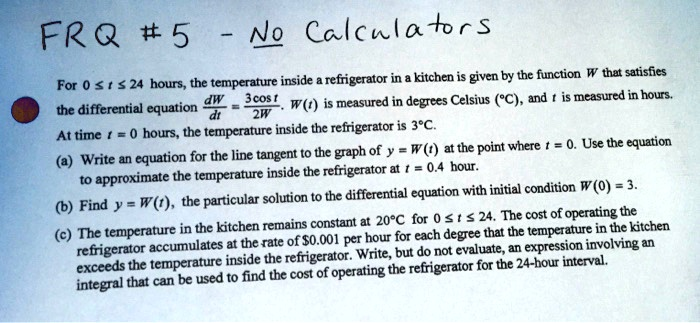
The Correct Answer and Explanation is:
Here are the correct answers and explanation for the problem.
Correct Answer
(a) The equation of the tangent line is W = 0.5t + 3. Using this line, the approximate temperature at t = 0.4 hour is W(0.4) ≈ 3.2°C.
(b) The particular solution is W(t) = √(3 sin(t) + 9).
(c) The expression for the total cost of operating the refrigerator for the 24 hour interval is:
Cost = ∫[from 0 to 24] 0.001(20 – √(3 sin(t) + 9)) dt
Explanation
This problem involves analyzing a differential equation that models the temperature inside a refrigerator. The solution requires applying calculus techniques for tangent line approximation, solving differential equations, and setting up a definite integral for a real world application.
Part (a): Tangent Line Approximation
To find the equation of the tangent line at t = 0, we first need a point and a slope. The initial condition gives us the point (t, W) = (0, 3). The slope of the tangent line is the value of the derivative dW/dt at this point. We substitute t = 0 and W = 3 into the given differential equation:
dW/dt = (3 cos(0)) / (2 * 3) = (3 * 1) / 6 = 1/2.
Using the point-slope form, W – W₁ = m(t – t₁), the tangent line equation is W – 3 = (1/2)(t – 0), which simplifies to W = 0.5t + 3. To approximate the temperature at t = 0.4 hour, we substitute t = 0.4 into this linear equation: W(0.4) ≈ 0.5(0.4) + 3 = 0.2 + 3 = 3.2°C.
Part (b): Particular Solution
To find the particular solution W(t), we use the method of separation of variables on the differential equation dW/dt = (3 cos(t)) / (2W). We rearrange the equation to group W terms with dW and t terms with dt:
2W dW = 3 cos(t) dt.
Next, we integrate both sides:
∫ 2W dW = ∫ 3 cos(t) dt
W² = 3 sin(t) + C
We find the constant of integration, C, using the initial condition W(0) = 3. Substituting these values gives 3² = 3 sin(0) + C, which simplifies to 9 = 0 + C, so C = 9. The particular solution is W² = 3 sin(t) + 9. Solving for W(t) yields W(t) = ±√(3 sin(t) + 9). Since the initial temperature W(0) = 3 is positive, we select the positive root, giving the final answer W(t) = √(3 sin(t) + 9).
Part (c): Cost Integral
The total cost is found by integrating the rate of cost over the 24 hour period. The cost accumulates at $0.001 per hour for each degree the kitchen temperature (20°C) exceeds the refrigerator’s temperature, W(t). The temperature difference at any time t is 20 – W(t). Therefore, the rate of cost in dollars per hour is 0.001 * (20 – W(t)). To find the total cost over the interval from t = 0 to t = 24, we integrate this rate:
Cost = ∫[from 0 to 24] 0.001(20 – W(t)) dt.
Substituting the expression for W(t) from part (b), we get the final integral expression for the total cost.