Position B sun Position A Position C Position D
The Correct Answer and Explanation is:
Position C
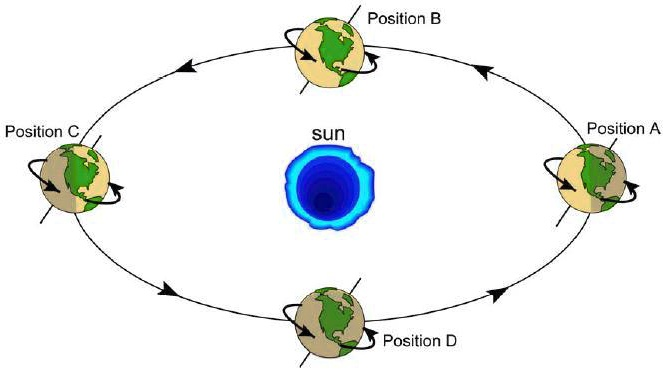
The correct answer is Position C. This position represents the beginning of summer in the Northern Hemisphere, an event known as the summer solstice. The Earth’s seasons are not caused by its changing distance from the Sun but by the 23.5 degree tilt of its rotational axis. This axial tilt remains constant and points in the same direction in space as the Earth revolves around the Sun.
In the provided diagram, the Earth’s North Pole is consistently shown tilted toward the right side of the image. When the Earth reaches Position C in its orbit, this consistent tilt causes the Northern Hemisphere to be angled most directly towards the Sun. Consequently, the Sun’s rays strike the Northern Hemisphere at a higher, more direct angle. This concentration of solar radiation delivers more energy per unit area, leading to warmer temperatures. Additionally, this position results in the longest day of the year for the Northern Hemisphere, as a larger portion of it remains illuminated during the Earth’s daily rotation. The combination of more direct sunlight and longer daylight hours marks the official start of summer.
Conversely, at Position A, the Northern Hemisphere is tilted away from the Sun, resulting in less direct sunlight and shorter days, which signifies the beginning of winter. Positions B and D represent the equinoxes, where the Earth’s tilt is neither toward nor away from the Sun. At these points, both hemispheres receive a similar amount of sunlight, leading to the more moderate temperatures of spring and autumn. Following the Earth’s counterclockwise orbit, Position B is the spring equinox and Position D is the autumnal equinox for the Northern Hemisphere. Therefore, Position C is uniquely the summer solstice.